
What if the biggest threat to your home's transformation isn't a design flaw, but the invisible moisture floating through the Nashville air? You've likely spent hours envisioning how a premium wood flooring selection might elevate your space, only to be met with conflicting advice about humidity and warping. It's completely normal to feel a sense of hesitation when choosing between engineered and solid hardwood, especially when you want a floor that adds genuine value without the risk of overpaying for the wrong grade.
We believe your home deserves a foundation that is as durable as it is beautiful. This guide will help you master the art of selecting the perfect materials for your Middle Tennessee residence by using our expert step-by-step framework. You'll gain a clear understanding of which species fits your specific interior style and how to navigate the technical requirements of the 2024 building codes. From initial inspiration to the final professional installation, we'll provide the clarity you need to move forward with absolute confidence.
Key Takeaways
- Learn why premium wood flooring remains the top choice for boosting home equity in Nashville, Franklin, and Brentwood.
- Identify the structural differences between solid and engineered hardwood to ensure your floors withstand local humidity fluctuations.
- Utilize the Janka Hardness Scale to select a species like White Oak or Hickory that offers the right level of durability for your household.
- Master a step-by-step framework for evaluating natural lighting and traffic levels before making your final selection.
- Understand the vital role of proper acclimation and professional installation in preventing long-term warping and structural failure.
Understanding Wood Flooring: More Than Just Aesthetics
Choosing wood flooring is one of the most significant decisions you'll make for your Middle Tennessee home. It's far more than a simple design choice; it's a long-term investment in your property's equity and your daily comfort. While other finishes may go out of style, high-quality wood remains the premier choice for interiors in Nashville, Franklin, and Brentwood. It offers a warmth and character that synthetic materials simply cannot replicate.
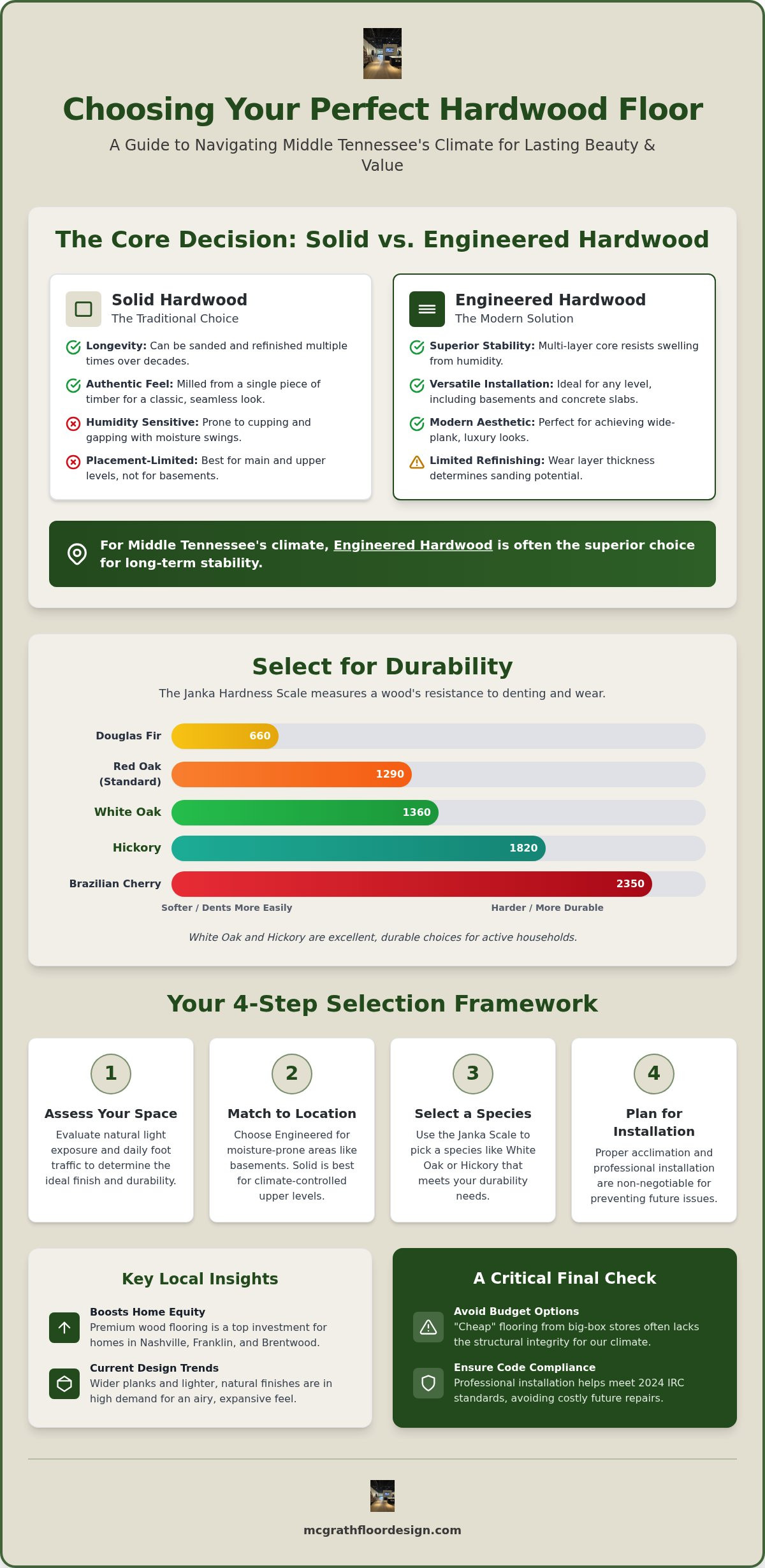
You'll generally choose between two primary categories: solid hardwood and engineered hardwood. Solid planks are cut from a single piece of timber, while engineered options feature a multi-layer core designed for stability. We often see homeowners tempted by "cheap" wood options found at big-box retailers. These budget materials frequently lack the wear-layer thickness or structural integrity required for our climate. Choosing inferior products can also lead to compliance issues with the 2024 International Residential Code standards now in effect across Metro Nashville, resulting in costly repairs or premature replacement down the road.
The Aesthetic Impact on Your Living Space
Wood flooring acts as the tonal foundation for your entire interior design. It dictates how light interacts with your furniture and how the room feels underfoot. There's a documented psychological benefit to incorporating natural materials into your living space, as it creates a sense of calm and organic connection. Whether you're matching the rustic charm of a Franklin farmhouse or the sleek lines of a modern Brentwood estate, the right texture and grain pattern can unify your vision.
Why Wood Flooring is a Nashville Staple
Hardwood has been a staple of Southern architecture for centuries, originally prized for its local availability and natural cooling properties. In 2026, we're seeing a distinct shift in Nashville's design preferences toward wider planks and lighter, natural finishes that make rooms feel airy and expansive. This choice isn't just about style; the resale value boost associated with hardwood flooring makes it a savvy financial move for any homeowner.
- Durability in high-traffic family areas.
- Natural insulation properties that improve energy efficiency.
- Ease of maintenance compared to traditional carpet.
- Consistent demand in the Franklin and Brentwood real estate markets.
By prioritizing quality and professional guidance, you ensure that your floors remain a source of pride rather than a maintenance burden. The right selection respects the history of your home while embracing modern performance standards.
Evaluating Solid vs. Engineered Hardwood for Tennessee Humidity
Humidity is the silent architect of your home's longevity. In Middle Tennessee, seasonal shifts in Relative Humidity (RH) can swing from 30% in the dry winter months to over 70% during the peak of a Nashville summer. Understanding how humidity affects wood floors is essential for ensuring your investment remains stable over time. Dimensional stability is the technical measure of how well a wood plank resists swelling and shrinking as it reacts to these environmental moisture changes.
The primary difference between your options lies in their physical construction. Solid planks are cut from a single, continuous piece of timber, while engineered options feature a multi-layer core where each layer is bonded at a 90-degree angle to the one above it. This structural variation determines where each product should be installed. While solid wood is often preferred for traditional main-level living areas, engineered wood flooring is the superior choice for basements or rooms with concrete subfloors where moisture levels remain higher.
Solid Hardwood: The Traditional Choice
Solid hardwood is celebrated for its longevity and its ability to be refinished multiple times over several decades. It provides an authentic feel that many homeowners in Franklin value for its historical resonance. However, its greatest strength is also its weakness. Because it is a single piece of organic material, it is highly susceptible to cupping and gapping when exposed to the heavy moisture of a Southern summer. To maintain its integrity, these floors require a strictly climate-controlled environment on upper levels of the home.
Engineered Hardwood: The Modern Solution
Learning what is engineered hardwood reveals why it has become the gold standard for many luxury Brentwood homes. Its cross-grain construction acts as a mechanical restraint, preventing the wood from expanding or contracting as aggressively as solid planks. This doesn't mean it's "fake" or lower quality. Premium engineered products feature a thick "wear layer" of genuine species like Oak or Walnut, providing the same visual depth as solid wood while offering vastly superior performance in our local climate.
- Solid Wood: Best for bedrooms and formal dining areas with consistent temperature control.
- Engineered Wood: Ideal for kitchens, basements, and homes with large windows where sunlight and humidity vary.
If you are unsure which structure fits your specific floor plan, our team can help you explore local flooring options that balance aesthetic vision with technical durability.
How to Select the Right Wood Species and Grade
Selecting the right wood flooring is a balancing act between your personal style and the physical realities of your household. You aren't just picking a color; you're choosing a biological material with specific performance traits. To make an objective choice, industry experts rely on the Janka Hardness Scale. This test measures the force required to embed a small steel ball into the wood, providing a clear rating of its resistance to dents and wear. Standards for these ratings are maintained by the National Wood Flooring Association to help homeowners understand which materials can withstand the rigors of daily life.
If you have active children or large pets, durability should be your primary focus. A species that ranks higher on the Janka scale will resist the inevitable impact of dropped toys or pet claws much better than softer alternatives. However, hardness is only one part of the equation. You must also consider the "grade" of the wood, which dictates the visual character and can significantly influence the final cost of your project.
Popular Species for Middle Tennessee Interiors
White Oak has become the versatile favorite for modern and farmhouse styles across Nashville. It features a neutral palette that takes stains beautifully and offers excellent resistance to rot and decay. For homeowners who prioritize maximum durability, Hickory is the ultimate choice. It's one of the hardest domestic species available, though its bold, high-contrast grain patterns require a thoughtful eye for design. If you're looking to create a sophisticated study or a luxury primary suite in Brentwood, Walnut provides unmatched warmth. While it's softer than Oak, its deep chocolate tones offer a level of refinement that is hard to replicate.
Understanding Wood Grades and Grain Patterns
The grade of your wood flooring refers to its visual appearance rather than its structural integrity. Clear Grade planks are selected for their uniform color and lack of knots, creating a sleek, contemporary aesthetic. Character Grade, sometimes called Rustic Grade, embraces natural knots, mineral streaks, and wide color variations. This option is often more budget-friendly and is excellent at hiding the minor scratches that occur over time.
The way a log is cut also impacts how the floor performs. Plain Sawn is the most common and displays the classic "cathedral" grain pattern. For superior stability in our humid climate, many homeowners opt for Rift and Quartered cuts. These methods produce a vertical grain that is much less likely to cup or gap, providing a high-end look that remains beautiful for decades.
The Step-by-Step Guide to Choosing Your New Wood Floors
Transforming your home's foundation requires a methodical approach that balances your daily reality with your aesthetic goals. Selecting wood flooring is not a decision to be rushed; it is a vision-to-reality process that benefits from careful planning. Follow this structured framework to ensure your new floors perform beautifully for decades.
- Step 1: Assess your lifestyle. Be honest about your home's activity levels. Do you have large pets with untrimmed claws, or children who frequently track in Middle Tennessee red clay? Identifying high-traffic zones and potential moisture exposure helps narrow your material choices immediately.
- Step 2: Evaluate your lighting. View your options under both natural sunlight and your home's specific artificial fixtures. A stain that looks warm in a bright showroom may appear significantly darker in a hallway with limited windows.
- Step 3: Define your budget. Establish a clear financial plan that accounts for both materials and labor. Understanding the price per square foot hardwood floor expectations in the current market allows you to prioritize quality where it matters most.
- Step 4: Request large-format samples. Small swatches are often misleading. Always ask for larger planks to lay out in your specific environment, allowing you to see grain variations across a wider surface area.
- Step 5: Consult a local expert. A professional subfloor inspection is the most critical step in the process. We identify hidden issues like uneven joists or moisture vapor transmission before they become expensive problems.
Assessing Your Home Environment
Your home's structural DNA dictates which products will succeed. We start by checking your subfloor type, as plywood requires different fastening techniques than a concrete slab. It's also vital to measure the average humidity in your home across different seasons. We pay close attention to transition points, ensuring a seamless flow between your new wood and existing ceramic or stone surfaces in kitchens and baths.
Defining Your Design Vision
Coordinating your wood color with existing cabinetry and trim creates a cohesive, high-end look. You'll need to choose between pre-finished planks, which offer a fast installation, and site-finished wood that allows for completely custom stains. Consider the plank width carefully. While narrow strips offer a traditional feel, wide-plank sophistication is the hallmark of modern Nashville luxury. If you're ready to see how these elements come together in your space, schedule a personalized design consultation with our team today.
From Selection to Professional Installation in Franklin and Brentwood
Even the most exquisite wood flooring is only as good as the hands that install it. In Middle Tennessee, the technical execution of your project is just as vital as the species selection. While it's tempting to focus solely on the visual transformation, the success of your new floors depends on a meticulous installation process that respects the unique climate of our region. Prioritizing craftsmanship over the lowest bid ensures that your investment remains a permanent asset rather than a temporary fixture.
The journey from a showroom sample to a finished living space requires a partner who understands the structural nuances of local architecture. We see many homeowners struggle with results from big-box retailers where the focus is on volume rather than precision. A high-quality flooring installation Franklin TN follows a rigorous protocol that begins long before the first plank is nailed down. This methodical approach is the only way to guarantee the durability and beauty you expect for your home.
The Importance of Wood Acclimation
Wood is a living, organic material that reacts to its environment. Before the installation begins, your new planks must reach an equilibrium with the specific climate of your home. This means the wood must sit in the intended rooms for 3 to 7 days to adjust to the interior humidity levels. Skipping this essential step is a recipe for disaster. If the wood is installed while it's too dry or too moist, you'll likely face issues like buckling, crowning, or unsightly gapping within the first year.
Professional installers don't guess when the wood is ready. We use specialized moisture meters to test both the subfloor and the new wood planks. We look for a specific moisture content range that aligns with the 2024 building code standards. Only when these numbers match do we proceed with the layout, ensuring your floor stays stable through every seasonal shift.
Why a Local Showroom Makes the Difference
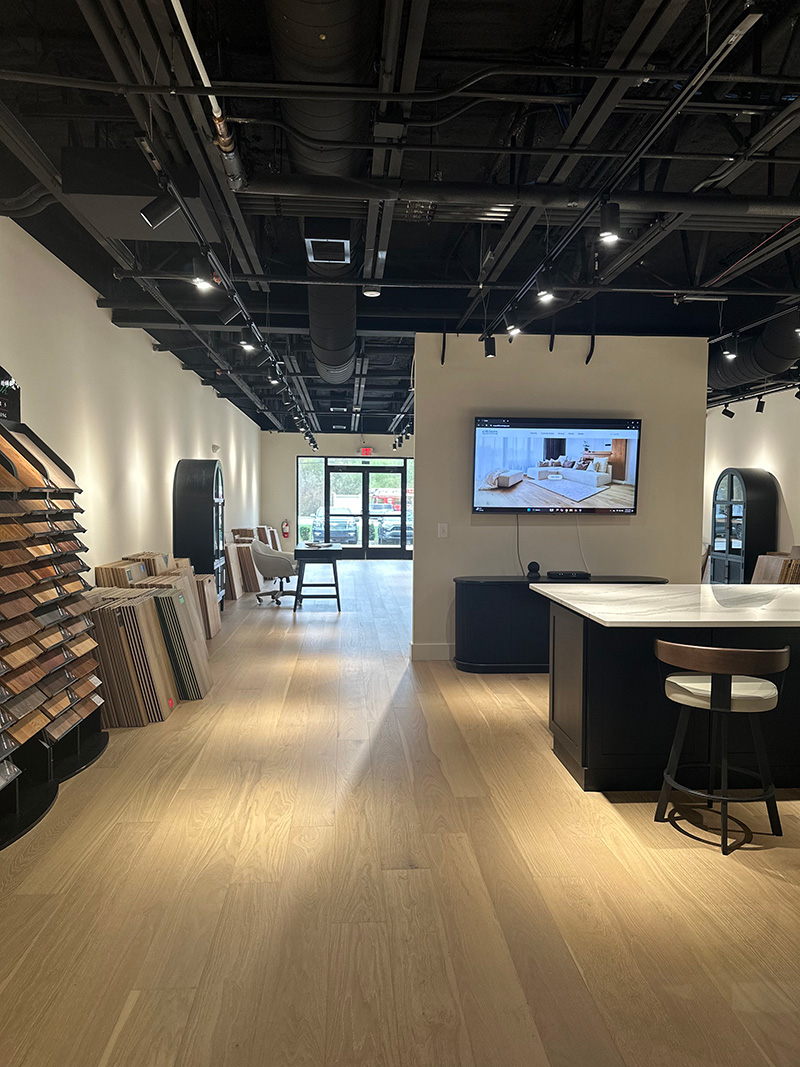
Choosing your materials in a local showroom provides a level of personalized guidance that a website or a warehouse cannot match. Experts who live and work in Middle Tennessee understand how different species perform in our specific humidity cycles. You'll have the opportunity to see full-sized displays that showcase the natural variations in grain and color, which is far more reliable than looking at a tiny swatch.
When you find hardwood flooring close to me, you're building a relationship with a partner who provides long-term support. We take pride in our "vision-to-reality" process, guiding you through every technical hurdle. This local accountability is what transforms a simple renovation into a seamless home improvement experience.
Building Your Nashville Legacy Underfoot
Selecting the right wood flooring is about more than just matching a color palette; it's about making a technical decision that respects the unique Middle Tennessee environment. You now understand how to navigate the nuances of local humidity, the importance of species durability, and why professional acclimation is non-negotiable for long-term success. By following a structured selection framework, you've moved from initial inspiration toward a reality that adds lasting equity and comfort to your living space.
Our team is here to guide you through every stage of this transformation. As a locally owned and operated partner in Middle Tennessee, we bring over 50 years of combined industry expertise to every project. We strictly adhere to NWFA-standard installation practices to ensure your floors perform as beautifully as they look. Let us help you turn your design vision into a durable, sophisticated reality that your family will enjoy for generations.
Explore Our Curated Wood Flooring Collections
Frequently Asked Questions
Is wood flooring better than laminate for Nashville homes?
Wood flooring provides superior long-term value and can be refinished multiple times, making it a premier investment for Nashville homes. While laminate offers excellent scratch resistance and handles moisture well, it can't be repaired if damaged. Real wood adds a level of sophistication and organic warmth that synthetic materials can't replicate. We recommend wood for main living areas to maximize home equity and laminate for high-moisture zones like mudrooms.
How long does wood flooring need to acclimate before installation?
Your new planks typically require between 3 and 7 days to reach equilibrium with your home's unique environment. This period allows the material to adjust to the specific humidity and temperature levels of your living space. Skipping this step often leads to structural issues like buckling or gapping later. Our expert installers always use precision moisture meters to verify that the wood is stable before we begin the nailing or gluing process.
What is the most durable wood flooring for homes with large dogs?
Hickory is the most durable domestic species for households with large pets because it ranks exceptionally high on the Janka Hardness Scale. Its dense grain structure resists deep scratches and indentations from claws better than softer woods like Walnut. Choosing a character grade with a matte finish also helps conceal minor wear and tear. We suggest selecting a species that balances extreme durability with a grain pattern that camouflages daily activity.
Can I install solid hardwood flooring over a concrete slab?
You shouldn't install solid hardwood directly over a concrete slab because concrete naturally holds and transmits moisture. This moisture often causes solid planks to cup or warp over time. Engineered wood is the safer and more reliable choice for these subfloors. Its cross-grain construction provides the dimensional stability needed to handle the vapor pressure from the concrete without compromising the structural integrity or the beauty of your finished floor.
How much does high-quality wood flooring increase home value?
High-quality wood installations consistently offer one of the highest returns on investment for Nashville homeowners. Real estate experts frequently highlight hardwood as a top feature that attracts buyers and justifies a higher asking price. Beyond the financial gain, it improves the overall marketability of your property. Buyers in Franklin and Brentwood view professional wood installations as a sign of a well-maintained home, often preferring it over carpet or synthetic alternatives.
What is the difference between site-finished and pre-finished wood?
Pre-finished wood arrives at your home already sanded, stained, and sealed with a durable factory coating. This allows for a faster, cleaner installation process. Site-finished wood is installed as raw planks and then sanded and stained in your home. This custom approach provides a perfectly flush surface and allows for completely unique color matching. While pre-finished is more convenient, site-finished offers a higher level of bespoke craftsmanship for luxury Nashville interiors.
How do I maintain wood floors in the humid Tennessee summer?
Maintaining a consistent indoor climate is the key to protecting your floors during a humid Nashville summer. You should aim to keep your home's relative humidity between 30% and 50% year-round. Use your air conditioning or a dedicated dehumidifier to prevent the wood from absorbing excess moisture and swelling. Avoid using wet mops or steam cleaners, as these can force water into the grain and cause permanent structural damage to the planks.
Is engineered wood flooring real wood?
Yes, engineered wood flooring is genuine wood from top to bottom. It features a high-quality wear layer of your chosen species, such as White Oak or Maple, bonded over multiple layers of structural plywood. This design isn't a cost-cutting measure; it's a technical improvement that provides superior stability in fluctuating climates. It offers the same visual beauty as solid planks while resisting the expansion and contraction caused by Nashville's seasonal humidity.


