
The toughest-looking floor isn’t automatically the right one for a busy home. The best flooring for high traffic areas depends on where wear happens, how much moisture or tracked-in grit a room sees, and how much upkeep fits your routine.
Daily foot traffic, pets, and spills can leave scratches, dents, stains, or a worn appearance. Durability claims can be hard to judge without considering how a floor performs in your actual rooms. A practical choice should suit both the demands of the space and the look you want to live with.
This guide compares hardwood, laminate, and ceramic for busy areas, and explains how to weigh traffic, room conditions, and care preferences before deciding. You’ll also find questions to ask about product specifications and installation, so you can look beyond broad claims. A flooring professional can help connect those details to your household’s routines and the rooms you’re updating.
Key Takeaways
- Choose flooring for high traffic areas by assessing how each room is used, where grit and spills collect, and what kind of wear your household creates.
- Compare hardwood, laminate, and ceramic by appearance, care needs, moisture considerations, and fit for your daily routines rather than looking for one universal winner.
- Look beyond durability claims. Room conditions, installation quality, and everyday maintenance all influence how a floor performs.
- Use a room-by-room checklist for traffic patterns, pets, spills, and cleaning preferences to narrow your choices in Franklin and Brentwood.
- Learn what to discuss with a flooring professional so material selection and installation can align with your home’s needs.
What Makes Flooring for High-Traffic Areas Hold Up?
High-traffic flooring is selected for the amount and type of daily use a room receives, including footfall, grit, spills, moisture, and the care needed to keep it looking good. The right choice balances those demands with the room’s conditions and your maintenance preferences.
“Durable” can describe several different qualities. A surface’s resistance to abrasion may help it withstand repeated contact, but that doesn’t automatically mean it resists scratches, dents, stains, moisture, or fading equally well. Product construction, finish, and manufacturer care guidance all affect real-world performance. For example, laminate flooring has a layered construction, but performance still depends on the specific product and installation conditions.
Which rooms in a home count as high traffic?
Look at how people move through your home, not just the room’s name. Entryways take the first hit from outdoor shoes, damp footwear, and soil. Hallways concentrate repeated steps along the same path. Kitchens combine regular movement with dropped food and occasional spills. Family rooms may see constant circulation, pets crossing the floor, and chairs or other furniture shifting around.
Household routines also affect exposure. More residents, frequent visitors, active pets, and shoes worn indoors can increase footfall or bring in more grit. A small entry may face tougher conditions than a larger living area if it regularly gets wet or dirty. Assess both how often people walk through and what they carry in.
What causes floors to show wear sooner?
Small particles can make a big difference over time. Grit under shoes rubs against a floor’s surface with each step, gradually dulling the finish or leaving visible marks. A mat near an entrance and regular sweeping or vacuuming can help remove debris before it travels farther into the home.
Moisture and everyday activity add other pressures. Damp shoes, unattended spills, or cleaning with a method that doesn’t suit the material may affect its appearance or cause damage. Dragging furniture can leave scratches or scuffs, so lift pieces when possible and use suitable protective pads. Sunlight can also affect some flooring materials or finishes. Ask about product-specific guidance for rooms with strong sun exposure.
No floor is automatically scratch-proof, stain-proof, or maintenance-free. Before choosing, consider which kinds of wear are most likely in each room and what care you’re willing to do. This gives you a clearer standard for comparing options than a broad promise of “heavy-duty” alone.
Hardwood, Laminate, or Ceramic: Compare Floors for Busy Rooms
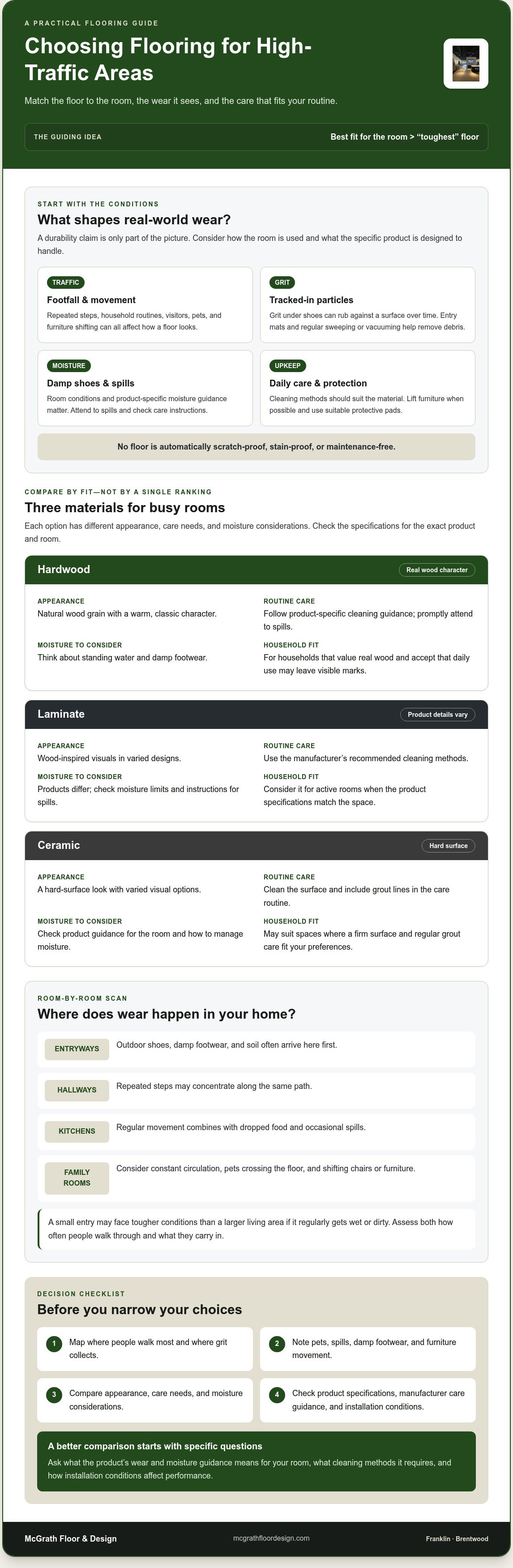
There isn’t one best floor for every busy room. Hardwood, laminate, and ceramic have different looks and care routines, so compare them against the conditions in your home. A surface that suits a family room may not be the most practical fit for an entry where wet shoes and grit collect.
| Material | Appearance | Routine care | Moisture considerations | Household fit |
|---|---|---|---|---|
| Hardwood | Natural wood grain and a warm, classic character | Follow product-specific cleaning guidance; promptly attend to spills | Consider exposure to standing water and damp footwear | Works for households that value real wood and accept that daily use may leave visible marks |
| Laminate | Can offer wood-inspired visuals in varied designs | Use the manufacturer’s recommended cleaning methods | Products differ; check moisture limits and instructions for spills | Consider it for active rooms if the product’s specifications match the space |
| Ceramic | Offers a hard-surface look with varied visual options | Clean the surface and include grout lines in the care routine | Check product guidance for the room and how to manage moisture | May suit spaces where a firm surface and regular grout care fit your preferences |
When can hardwood suit a busy household?
Hardwood brings the distinct grain and natural variation of real wood to a room. Thoughtful care helps preserve its appearance. Before choosing it for a high-use space, consider how often shoes or pets cross the floor, whether spills are likely, and how comfortable you are with visible wear developing over time. Review the hardwood flooring homeowner’s guide for more selection context.
How do laminate and ceramic fit high-use spaces?
Laminate products vary in construction and performance, so don’t assume every option has the same wear or moisture limits. Check the specifications and care instructions for the exact product and room. The laminate flooring guide offers more detail. Ceramic provides a hard surface, but grout lines also need attention as part of routine cleaning. Explore the ceramic flooring guide for further considerations.
Comfort matters, too. A firm surface may feel different underfoot than wood, and your preference for cleaning grout or managing spills can shape what feels practical. The right flooring for high traffic areas is the material whose appearance, care needs, and room-specific limitations suit your everyday routine. To compare hardwood, laminate, and ceramic options, explore flooring choices with McGrath Floor & Design.
Does the Toughest Flooring Always Make the Best Choice?
A floor’s hardness is only one part of its performance. A very hard surface may resist some kinds of wear but still be a poor match for a room’s moisture exposure, your comfort preferences, or the care routine you’re willing to follow. The best flooring for high traffic areas depends on how traffic interacts with room conditions, product specifications, installation, and everyday maintenance.
Traffic level alone can’t identify the right floor. The same busy household may create different demands in different rooms: an entry sees grit and damp shoes, a kitchen may have spills, and a family room may need a surface that feels comfortable during long stretches of use.
Can a durable floor still be wrong for a room?
Yes. A product may perform well under one type of use but have limitations that matter in another setting. Hardwood, laminate, and ceramic each involve trade-offs, and no material is automatically suited to every busy room. Consider likely exposure to water, how quickly spills can be addressed, whether you prefer a softer or firmer feel underfoot, and how much routine care you can manage.
Read the manufacturer’s guidance for the specific product before choosing it for a kitchen, entry, or other demanding space. Check instructions for moisture exposure, cleaning methods, and appropriate use. Specifications can differ by product construction and finish, as well as between manufacturers, so don’t rely on a material label alone. A flooring professional can help interpret the details for your room and routine.
Why installation and maintenance affect long-term results
Even a well-chosen product needs a sound installation. Preparation and installation affect how the finished floor sits and performs. The condition of the surface beneath it, along with the product’s installation requirements, are important parts of the project. Discuss preparation, installation methods, and room-specific considerations with your flooring professional before work begins.
Protect the floor with care suited to its material. Use the manufacturer’s recommended cleaning products and methods, remove grit regularly, and respond to spills according to the product instructions. Don’t assume a surface can tolerate every cleaner or amount of moisture. Small habits, such as lifting furniture instead of dragging it, can help reduce avoidable marks.
No flooring is immune to damage or maintenance-free. Set realistic expectations by asking what types of wear a product is designed to handle, what conditions may affect it, and what ongoing care it requires. That shifts the decision away from “Which floor is toughest?” and toward a more useful question: “Which floor fits this room and the way we live?”
How to Choose Flooring for Busy Rooms in Middle Tennessee
For homeowners in Franklin, Brentwood, and nearby communities, start by assessing each room’s routine. Don’t choose from appearance alone. Map where people walk, what gets carried inside, and which areas regularly face spills or moisture.
- Trace the busiest routes. Note the paths from exterior doors through entryways, hallways, kitchens, and connected living spaces. Look for spots where shoes pause, pets wait, or people turn often. These areas may collect more grit or show wear sooner.
- Record who and what uses each room. Children playing, pets crossing the floor, frequent guests, indoor shoes, and moving furniture can all shape the kind of wear to expect. Consider whether chairs are often pulled out or a pet’s water bowl sits nearby.
- Separate damp or spill-prone spaces from dry rooms. An entry exposed to damp footwear and a kitchen where spills happen have different needs from a mostly dry living area. Seasonal humidity and indoor moisture are worth discussing, too. Ask how the specific product should be selected and installed for your home’s conditions rather than assuming one material suits every room.
- Compare care routines and product details. Ask which manufacturer specifications address your room’s expected traffic, moisture exposure, and cleaning methods. Confirm what routine care involves and which cleaners or practices the product guidance recommends.
- Review the installation plan and actual samples. Ask what preparation the room needs, how transitions between flooring areas will be handled, and what project steps to expect. Compare samples in the rooms where they’ll be installed, and observe how their color and texture look in your home’s lighting.
Sample checklist: Compare each option for room use, foot traffic, grit, spills, pets, moisture guidance, cleaning needs, appearance, and installation requirements.
Bring those notes to a flooring professional so the conversation can focus on your actual rooms, not broad claims about which material is “best.” McGrath Floor & Design serves the Greater Nashville area, including Franklin and Brentwood, and can guide homeowners through hardwood, laminate, and ceramic selection and professional installation. Discuss flooring options for your busy rooms with the team.
Plan a High-Traffic Flooring Project with McGrath Floor & Design
Choosing a floor is easier when the conversation starts with your household, not a product label. McGrath Floor & Design helps homeowners connect room use and care preferences with hardwood, laminate, and ceramic options, then plan for professional installation. The company serves the Greater Nashville area, including Franklin and Brentwood.
Before meeting with a flooring professional, gather details that make your home’s needs clear. Bring room measurements, photos, and notes about the existing floor’s condition. Include practical details: where household members walk most, whether pets cross the room, where grit or damp shoes collect, and which areas see spills. If easy cleanup is a priority, mention your preferred cleaning routine so it can be considered alongside appearance and product guidance.
For homeowners planning a project in Franklin, the Franklin flooring installation guide offers additional context as you prepare. A little preparation helps the team understand what matters most and focus the material discussion on your rooms rather than general claims about durability.
From material selection to professional installation
McGrath’s team guides customers through material selection and installation planning. Share your priorities, then discuss how hardwood, laminate, and ceramic compare for the intended space. Ask about the specific product’s care instructions, use limitations, and relevant specifications. It’s also useful to clarify what room preparation may be needed, how adjacent flooring areas will transition, and which steps are part of the installation plan.
The aim is a considered match: flooring for high traffic areas that reflects how your household lives while respecting each room’s conditions. Samples can help you assess color and texture in context, while product information helps you evaluate practical requirements. Together, these details turn a broad idea into a clearer project plan.
McGrath Floor & Design was founded in 2004, and its owners and partners bring more than 50 years of combined industry experience. That experience supports a guided, listen-first process, with attention to both the finished look and the details involved in installation.
If you’re weighing flooring choices for a busy room, bring your questions, room details, and priorities to the conversation. Explore flooring options with McGrath Floor & Design and discuss which materials and installation considerations may suit your home.
Make Your Next Flooring Choice with Confidence
A successful flooring project starts with the way your home actually works. Match the material to each room’s routine, compare care and product guidance, and look beyond hardness alone when judging how a floor may perform. These steps can help you choose flooring for high traffic areas that suits your household as well as your home’s design.
McGrath Floor & Design serves the Greater Nashville area, including Franklin and Brentwood, with hardwood, laminate, and ceramic flooring, along with professional installation. The company was founded in 2004, and its owners and partners bring more than 50 years of combined industry experience.
Share your room priorities and questions with a local guide, then explore material options at a pace that feels comfortable. Explore flooring options with McGrath Floor & Design and take the next step toward a floor that suits your everyday life.
Frequently Asked Questions
What is the best flooring for high-traffic areas?
There’s no single best floor for every busy room. The right choice depends on traffic, moisture, expected wear, and your preferred care routine. Hardwood offers natural wood character, laminate products vary in wear and moisture guidance, and ceramic has a firm surface with grout lines to maintain. Compare the product’s specifications with the room’s conditions, then consider how its appearance and upkeep fit your household.
Is hardwood flooring suitable for a busy household?
Yes, hardwood can suit a busy household if its product guidance and care needs fit the room. Consider where shoes, pets, and furniture move, whether spills are likely, and how you feel about visible marks that can develop with use. Ask about cleaning instructions and room suitability before choosing a specific product. Hardwood may be a good fit for homeowners who value natural wood and are comfortable caring for it.
Is laminate flooring a good choice for hallways and entryways?
Laminate may work in a hallway or entryway, but check the exact product’s specifications before deciding. Products can differ in construction, wear characteristics, and limits for moisture exposure. Consider whether wet footwear or tracked-in grit is common, and review the manufacturer’s cleaning and spill guidance. A covered, dry hallway may present different demands from an entry that regularly encounters damp shoes or soil.
Can ceramic flooring handle heavy foot traffic?
Ceramic can be suitable for busy rooms, but confirm that the specific product is appropriate for its intended use. Consider the room’s traffic, the manufacturer’s guidance, and the installation plan rather than relying on the material name alone. Include grout in your upkeep expectations, since joints can collect dirt and need routine attention. Also consider whether a firm surface feels comfortable for your household.
What type of flooring is easiest to maintain in a busy home?
The easiest flooring to maintain depends on which cleaning tasks you find manageable and on the product’s care instructions. A smooth surface may be straightforward to sweep, while ceramic grout adds another area to clean. Hardwood and laminate also require care suited to their specific finishes and manufacturer guidance. Compare recommended cleaning methods before selecting a floor, especially if you prefer a simple, consistent routine.
How can I protect flooring from dirt and scratches?
Reduce grit at entrances with mats and sweep or vacuum regularly so abrasive particles don’t keep moving across the floor. Wipe up spills according to the product’s instructions, and use suitable protective pads under furniture. Lift items instead of dragging them when rearranging a room. These habits can help limit avoidable wear, though they can’t make a floor immune to scratches, stains, or other damage.
Does flooring installation affect how well a floor holds up?
Yes, installation and preparation can affect how the finished floor performs. Ask what condition the underlying surface needs to be in, what preparation is planned, and how transitions between rooms will be handled. Follow the product’s installation and care guidance. Homeowners in Franklin and Brentwood can discuss material selection and professional installation with McGrath Floor & Design, which serves the Greater Nashville area.


