
In the 2026 Nashville housing market, a hardwood floor isn't just a surface; it's a strategic investment in your home's climate resilience and future resale value. You likely understand that premium materials add character to a space, yet it's easy to feel frustrated by the massive price gap between various wood species. When calculating the price per square foot hardwood floor, many homeowners in Franklin and Brentwood find themselves wary of low-ball estimates that inevitably lead to expensive change orders. You want a floor that stands up to Tennessee's humidity without the stress of hidden costs.
We agree that transparency is the foundation of a successful home transformation. This guide promises to provide a clear, line-item breakdown of the total investment, covering everything from material selection to professional installation standards. We will explore the specific factors that influence your budget, including subfloor preparation and why certain species thrive in our unique Middle Tennessee environment. You'll gain the confidence to choose a material that balances aesthetic beauty with the meticulous craftsmanship your home deserves.
Key Takeaways
- Understand how a professional estimate integrates materials, labor, and finishing into one cohesive project total.
- Evaluate how wood species and grades influence your budget and the long-term character of your Nashville home.
- Spot hidden variables such as subfloor preparation and material disposal to ensure your initial budget remains accurate.
- Learn why the true price per square foot hardwood floor reflects the value of craftsmanship and local climate expertise.
- See how a curated showroom experience helps you visualize the final transformation while securing your material warranties.
Breaking Down the Price Per Square Foot: What Are You Actually Paying For?
A professional estimate is far more than a simple multiplication of room dimensions. While homeowners often begin their journey by looking at a raw price per square foot hardwood floor, that figure usually only represents the material itself. In the current 2026 Middle Tennessee market, a comprehensive project budget must account for a sophisticated "all-in" price. This holistic view encompasses the high-quality planks, the specialized underlayment, professional labor, and the precision finishing required to protect your investment. Transitioning from a retail price tag to a reality-based project estimate is the first step in ensuring your home transformation remains on track without unpleasant surprises. Your home deserves precision.
The Three Pillars of Your Flooring Budget
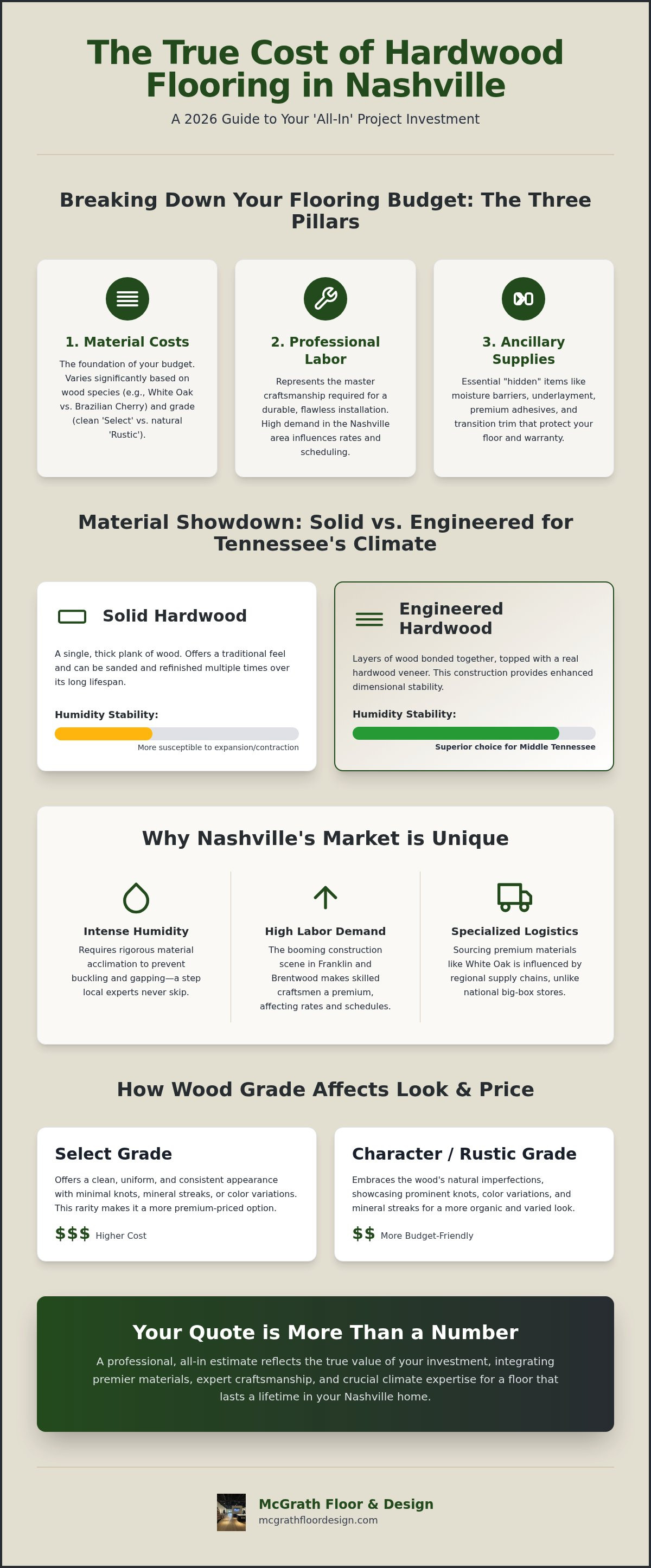
Every successful installation rests on three primary financial components. First, material costs vary significantly based on the species and grade of the timber. Whether you select a rustic character grade or a clean, uniform select grade, the timber's origin impacts the initial outlay. Second, professional labor represents the technical expertise required to ensure your floor doesn't fail. Master craftsmen bring decades of experience to handle complex cuts and ensure the wood is laid with structural integrity. Finally, ancillary expenses include the essential "hidden" items like moisture barriers, premium adhesives, and transition trim. These components are vital for maintaining the manufacturer's warranty and the long-term health of your home.
Why National Averages Often Fall Short for Nashville Homes
Broad national estimates rarely reflect the reality of the booming Nashville construction landscape. Local demand for skilled labor in areas like Franklin and Brentwood remains exceptionally high, which directly influences project scheduling and professional rates. Additionally, sourcing various types of wood flooring like premium White Oak requires specialized logistics that can fluctuate based on regional supply chains. Perhaps most importantly, our Middle Tennessee humidity necessitates a rigorous material acclimation period. A local expert understands that rushing this process to meet a generic national timeline often results in buckling or gaps. This local perspective is indispensable for a durable finish. Remember that a generic price per square foot hardwood floor is merely a starting point, not a final quote for a masterfully finished space.
Material Selection: How Species and Grade Impact Your Budget
Your choice of species is the soul of the room. While exotic imports like Brazilian Cherry offer a dramatic, deep-red palette, domestic hardwoods like Hickory and White Oak provide superior stability for the Tennessee climate. Local homeowners frequently select white oak hardwood flooring for its neutral undertones and incredible durability. Beyond the species, the "Grade" of the wood determines the visual character and the final cost. A "Select" grade offers a clean, uniform look with minimal knots, whereas "Character" or "Rustic" grades embrace natural imperfections like mineral streaks and large knots. The visual grade you select directly influences the price per square foot hardwood floor, as clearer cuts of timber are naturally rarer and more sought after.
The NWFA Homeowner's Handbook serves as a vital resource for understanding these distinctions before you commit to a purchase. It's a helpful guide that aligns with our commitment to professional standards. Understanding these details helps you navigate the total price per square foot hardwood floor without sacrificing the long-term beauty of your home. If you're feeling overwhelmed by the choices, a visit to a curated showroom can help you see these differences in person.
Solid vs. Engineered Wood: A Cost-Benefit Analysis
Nashville's humidity plays a massive role in material performance. Solid hardwood is a single, thick piece of wood that offers a traditional feel and can be refinished multiple times over many decades. However, engineered hardwood is often the superior choice for Middle Tennessee. Its layered construction provides enhanced dimensional stability, meaning it's less likely to cup or gap when the summer humidity hits. While some entry-level engineered products are budget-friendly, high-end versions with thick wear layers can actually exceed the cost of solid planks. You're paying for the engineering that keeps your floor flat and beautiful in a challenging environment.
The Cost of Style: Width, Texture, and Finish
Modern design trends in 2026 lean heavily toward wide-plank aesthetics. Planks measuring five inches or wider create a sophisticated, expansive feel, but they require more mature timber and carry a price premium. Texture also adds to the labor cost at the factory level. Wire-brushed or hand-scraped finishes hide everyday wear and tear effectively, but they involve more manufacturing steps than a smooth finish. Finally, you must choose between pre-finished planks, which are stained at the factory, or site-finished floors. Site-finishing allows for complete custom color control and a seamless look, though it requires more time and specialized labor in your home.
Labor and Professional Installation Costs in Middle Tennessee
Labor is the bridge between a stack of raw timber and a masterwork under your feet. In our local Middle Tennessee market, professional installation rates reflect the high demand for skilled craftsmen who understand the nuances of high-end residential projects. While you might see a base price per square foot hardwood floor on a retail tag, the labor required to install those planks correctly is where the true value lies. Choosing an installer who follows NWFA-aligned standards ensures that your investment is protected by a valid warranty and a meticulous eye for detail. This expertise is particularly vital in Franklin and Brentwood, where home values demand nothing less than perfection.
Don't fall into the "cheap labor" trap. Entry-level quotes often ignore the technical requirements of high-quality materials, leading to structural failures that cost thousands to repair later. A seasoned expert acts as your guide, ensuring that the installation process is as seamless as the finished floor itself. We believe in a "listen-first" mentality, meaning your specific vision for the space dictates the technical approach we take.
Standard vs. Complex Installation Patterns
Complexity is the primary driver of labor variances. A standard straight-lay installation provides a clean, classic look and serves as the baseline for your budget. However, more intricate designs like a herringbone wood floor require significantly more time for precision cutting and layout alignment. These specialized patterns carry a labor premium because they demand a higher level of technical mastery. Similarly, adding diagonal layouts or custom borders will influence the final price per square foot hardwood floor for your project. It's also vital to remember that staircases are unique; they are almost always priced per tread and riser rather than by area, as they involve intense detail work that square footage simply doesn't capture.
The Importance of Acclimation and Moisture Testing
Nashville's humidity is a relentless force that can easily ruin an expensive floor if ignored. Professional installers treat moisture testing as a non-negotiable part of the process, checking both the new planks and your existing subfloor. This ensures the wood has reached its equilibrium moisture content before the first nail is ever driven. Acclimating the material to your home's specific environment prevents the cupping, crowning, or gapping that often plagues "discount" installations. By investing in a seasoned expert who prioritizes these technical steps, you avoid the frustration of future repairs and ensure your floor remains stable for decades to come.
Site Preparation and Hidden Variables: Budgeting Beyond the Planks
When you review an estimate, the price per square foot hardwood floor often reflects the visible surface, yet the work happening beneath that wood is what ensures a lifetime of performance. Site preparation represents the most common area where "low-ball" estimates fail. Unexpected structural needs often emerge once the old flooring is removed. We believe in providing a holistic view of your project from the start, identifying potential "budget-killers" before they cause delays. A successful transformation requires a meticulous approach to the environment surrounding your new floors, from the subfloor to the finishing trim. Your home's foundation dictates the longevity of your new surface.
Logistical factors also play a significant role in your final project total. Removing and disposing of existing materials like heavy tile or old carpet involves specialized labor and disposal fees that aren't always included in a basic material quote. You should also account for the movement of heavy furniture and the temporary disconnection of appliances. These steps are essential for a seamless installation. To ensure your budget covers every detail, schedule a professional site assessment with a local expert who understands the structural realities of Middle Tennessee homes.
Subfloor Integrity: The Foundation of Your Investment
The condition of your subfloor is the primary factor in preventing annoying squeaks and premature wear. Plywood subfloors and concrete slabs require different preparation methods and adhesive types. In our humid climate, high-performance moisture barriers are a non-negotiable expense for protecting your investment. We carefully identify "high spots" and "low spots" across the room to ensure a perfectly flat surface. If these variances aren't addressed during the prep phase, even the most expensive planks will eventually fail. Addressing these foundational issues early is the only way to guarantee a quiet, stable floor for decades.
Trim, Transitions, and Finishing Touches
Precision finishing defines a professional installation. In historic Franklin homes, matching new hardwood to existing original trim requires an expert eye and custom-stained solutions. While stock moldings are available, they often lack the sophisticated flow required for a high-end residential project. Transition strips, baseboards, and shoe molding must be integrated thoughtfully to create a cohesive look between rooms. These "small" details often represent the difference between a functional floor and a masterwork of craftsmanship. Budgeting for custom-stained transitions ensures that every element of your home's design feels intentional and refined.
Maximizing ROI: Why a Local Showroom Beats Big-Box Estimates
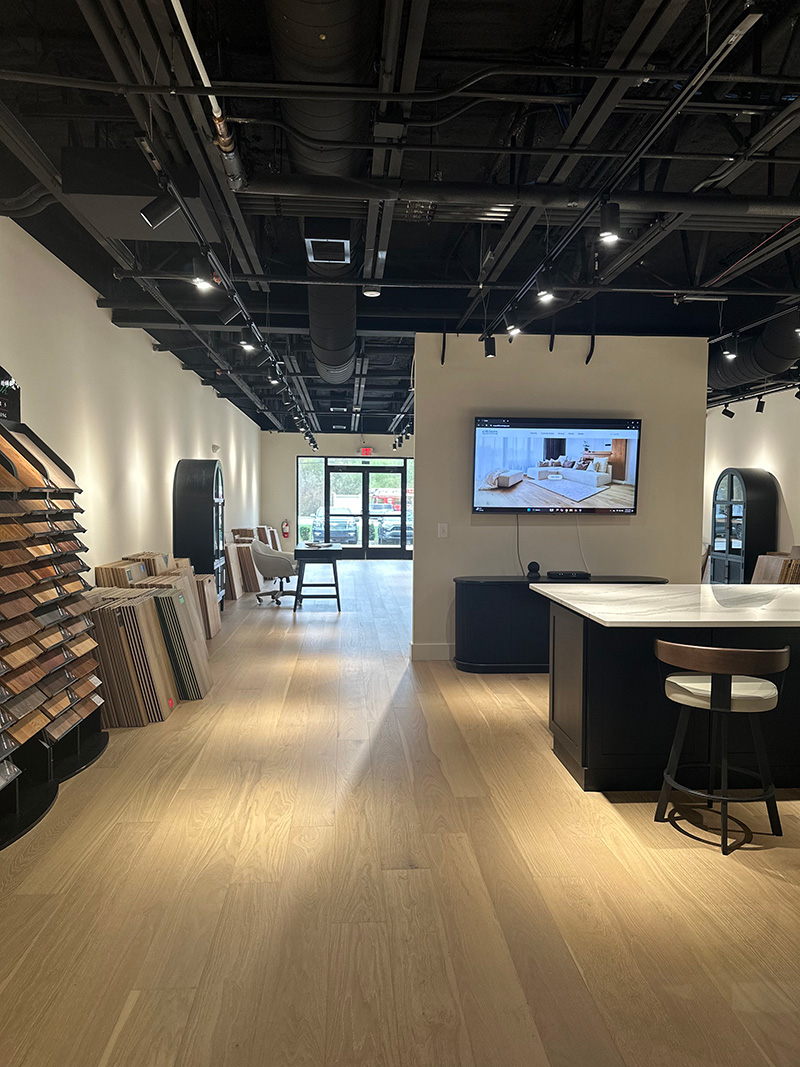
Choosing where to buy your flooring is just as critical as the wood itself. While it's tempting to browse the aisles of a massive retailer, those environments lack the specialized insight required for high-end residential work. When you search for hardwood flooring close to me, you aren't just looking for a product; you're looking for a partner who understands the architectural nuances of Franklin and Brentwood. A dedicated showroom allows you to view large-format samples that reveal the true variation in grain and color. This perspective is vital. A small swatch cannot possibly show the full character of a premium White Oak plank, and seeing the wood at scale prevents aesthetic regrets. Relying on a curated showroom ensures you avoid expensive material mistakes while finding a floor that perfectly aligns with your home's unique light and layout.
Personalized guidance is the secret to a successful "vision-to-reality" transformation. At McGrath Floor & Design, we act as your dedicated guide, helping you understand how the price per square foot hardwood floor translates into long-term durability and beauty. We prioritize trust over aggressive sales tactics, ensuring you feel confident in every decision. Your home deserves a level of attention that big-box stores simply cannot provide. By choosing a local expert, you're investing in a relationship that values your specific vision as much as the technical integrity of the installation.
The True Cost of DIY vs. Professional Installation
The DIY route often appears budget-friendly on paper, but the hidden costs accumulate quickly. Specialized tool rentals, such as professional-grade sanders and pneumatic nailers, add significant expense and logistical stress. Additionally, an inexperienced hand often leads to higher material waste, which can drive up your total price per square foot hardwood floor unexpectedly. Perhaps most importantly, professional installation provides a unified warranty covering both the product and the labor. This security is a major selling point in the competitive Nashville housing market. A masterfully finished floor increases your home's resale value and ensures the material warranty remains intact, providing peace of mind that a weekend project cannot match.
Consultation and Project Management
A digital calculator can give you a rough idea, but an in-home estimate is the only way to achieve true accuracy. We assess the structural realities of your space, identifying subfloor needs and transition complexities that an online tool would miss. Having a single point of contact for the entire project eliminates the confusion of managing multiple contractors. We handle the logistics, from material acclimation to the final coat of finish, so you can focus on the joy of your new space. We invite you to visit our showroom in Franklin for a personalized quote. Let us help you turn your flooring vision into a reality with the meticulous care your home deserves.
Investing in the Future of Your Nashville Home
Transforming your living space is a journey that begins with absolute clarity. We've explored how a realistic price per square foot hardwood floor involves more than just the planks themselves, encompassing meticulous subfloor preparation and the technical mastery of NWFA-compliant installation. You now understand that selecting a climate-resilient species like White Oak isn't just an aesthetic choice; it's a strategic move to protect your home's value against Middle Tennessee's humidity. By prioritizing professional guidance over big-box convenience, you ensure that every detail, from custom transitions to material acclimation, is handled with the care your property deserves.
Our team brings over 50 years of combined industry experience to every project in Nashville, Franklin, and Brentwood. We offer a curated selection of premium hardwood and laminate designed to withstand the test of time while elevating your home's design. Don't leave your vision to chance or generic estimates. Schedule Your Professional Flooring Consultation today to begin your vision-to-reality transformation. We're ready to act as your dedicated guide in creating a space you'll love for decades to come.
Frequently Asked Questions
What is the average price per square foot for hardwood floor installation in 2026?
Market data for 2026 indicates that Nashville metro area homeowners typically see labor rates between $8 and $10 per square foot. When factoring in materials, the total price per square foot hardwood floor varies based on the wood's origin and grade. A standard 1,282 square foot project in Middle Tennessee often ranges from $9,524 to $11,847 for the complete installation, depending on the complexity of the space.
Does the price per square foot include the removal of old carpet or tile?
No, standard material or installation quotes usually exclude the removal and disposal of existing flooring. Removing old carpet is generally straightforward, but extracting heavy ceramic tile requires specialized equipment and significantly more labor. These services are typically billed as separate line items. Including these costs upfront prevents budget surprises and ensures your site is properly prepared for the precision work required for a new hardwood installation.
Why is engineered hardwood sometimes more expensive than solid wood?
High-end engineered hardwood features sophisticated multi-layer construction and thick wear layers that can exceed the cost of solid planks. This engineering provides superior dimensional stability, making it ideal for the fluctuating humidity levels found in Nashville. While entry-level options exist, premium engineered products use high-quality veneers and marine-grade birch cores. These materials command a higher market price due to their enhanced durability and performance in Southern climates.
How much should I budget for subfloor preparation in a Nashville home?
Budgeting for subfloor prep depends on the current condition of your home's foundation. While minor leveling might be standard, significant height variances or moisture issues in older Franklin homes can increase the project total. A professional site assessment is the only way to identify these needs accurately. Investing in a flat, dry subfloor early prevents future squeaks and ensures your material warranty remains valid over the long term.
Are there hidden costs I should watch out for when looking at flooring quotes?
Common hidden costs include transition strips, shoe molding, and moisture barriers. Many basic quotes only cover the main price per square foot hardwood floor material, leaving out the essential trim work that creates a finished look. You should also ask about furniture moving, appliance disconnection, and the cost of material delivery. A transparent, line-item estimate from a local expert will account for these variables before the work begins.
How does the wood species (like White Oak vs. Pine) affect the total price?
Wood species is a primary driver of material cost due to availability and hardness. White Oak is a premium choice for Nashville homes because of its durability and neutral grain, typically costing more than softer woods like Pine. Exotic species often carry higher shipping and logistics fees. Choosing a domestic hardwood usually offers a better balance of performance and value for the unique environmental challenges found in Middle Tennessee.
Is it cheaper to buy the wood myself and hire a separate installer?
While buying wood independently might seem cost-effective, it often leads to higher total expenses and logistical headaches. Professional installers often receive trade pricing and can ensure the material is stored and acclimated correctly. Additionally, separate sourcing can complicate warranty claims if a product failure occurs. A unified contract covering both sales and installation provides a single point of accountability and protects your long-term investment through professional standards.
How much extra material should I order for waste and cuts?
The industry standard is to order 10% to 15% more material than your actual measured square footage. This overage accounts for necessary cuts, board selection, and natural waste during the installation process. If you've chosen a complex layout like a herringbone pattern, you should lean toward the 15% mark. Having extra planks on hand also provides a safety net for any future repairs or unexpected board replacements years down the road.


