
Your kitchen floor is the hardest-working member of your team, yet it's often the most overlooked until a health inspector arrives or an employee slips. In the high-stakes world of Tennessee hospitality, choosing the right commercial tile flooring in Brentwood isn't just a design choice; it's a critical safety and compliance strategy. A single mistake in material selection or grout type can lead to costly downtime or even permanent closure. You need a foundation that works as hard as your chefs do every single shift.
We understand that the pressure to maintain a pristine, accident-free environment while managing a busy kitchen is immense. You want a surface that stands up to high-temperature grease and heavy foot traffic without failing. This guide will help you master the technical 2026 standards, from the mandatory 0.55 wet DCOF slip-resistance ratings to the necessity of 100% solids epoxy grout. We'll explore the best-performing through-body porcelain options, local health department mandates, and professional installation techniques that minimize business downtime. Let's transform your vision into a durable reality that lasts 15 years or more.
Key Takeaways
- Learn how to meet 2026 slip-resistance standards, including the critical 0.55 DCOF rating required for grease-prone cooking zones.
- Compare the performance of through-body porcelain and traditional quarry tile; ensure your material choice stands up to high-heat commercial environments.
- Discover the essential role of specialized subfloor preparation and waterproof membranes in preventing long-term structural damage.
- Secure your business's future by selecting commercial tile flooring in Brentwood that meets stringent Tennessee health code mandates, eliminating dirt traps.
- Gain professional insight into why 100% solids epoxy grout is the industry standard for resisting grease and bacterial growth in professional kitchens.
The High Stakes of Brentwood Commercial Kitchen Flooring
Brentwood's dining scene is defined by high standards and meticulous attention to detail. Behind the polished mahogany and soft lighting of the dining room lies the high-pressure environment of the commercial kitchen. Here, your floor faces a relentless assault of boiling oils, heavy equipment, and constant foot traffic. Choosing the right commercial tile flooring in Brentwood is a decision that impacts your bottom line as much as your menu does. It's the literal foundation of your operational success.
Standard residential tiles simply aren't built for this level of intensity. They lack the structural density to withstand the weight of industrial ovens or the thermal shock of nightly deep cleaning. When a floor fails, the cost isn't just the price of the tile; it's the high cost of business downtime and potential health code violations. A well-specified floor protects your investment and boosts your team's morale by providing a stable, professional workspace. Your staff deserves a surface that won't fail them during the Friday night rush.
Durability Requirements for Middle Tennessee Businesses
In Middle Tennessee, commercial kitchens often house heavy rolling loads like ingredient carts and mobile refrigeration units. These put immense pressure on the bond between the tile and the subfloor. We prioritize materials with a high PEI (Porcelain Enamel Institute) rating. This rating indicates the tile's ability to resist surface wear and abrasion from continuous movement. Without this resilience, tiles can chip or crack, creating dangerous trip hazards and pockets where bacteria can hide.
Thermal shock is another silent killer of kitchen floors. When your crew sprays a hot floor with cold water during a washdown, the rapid temperature change can cause inferior materials to buckle or delaminate. Manufacturers engineer professional-grade ceramic and quarry tile to expand and contract without compromising their structural integrity. This resilience ensures that your flooring remains intact through years of temperature fluctuations and rigorous sanitation cycles.
The Aesthetic-Performance Balance
Your brand's commitment to excellence shouldn't stop at the kitchen door. While performance is paramount, the visual appeal of your back-of-house areas influences how your staff perceives their workplace. A clean, professional environment fosters a sense of pride and safety among your culinary team. When you invest in high-quality commercial tile flooring in Brentwood, you're signaling to your employees and health inspectors that you value quality in every square inch of your facility.
Sophisticated businesses in the area often opt for through-body porcelain that mimics the elegance of the front-of-house while providing industrial-strength traction. Selecting the right color palette is also a strategic move. Mid-tone grays and earthy browns are excellent for hiding the inevitable scuffs of a busy service. These tones make it easy for your cleaning crew to spot and address spills before they become slip hazards. This balance of beauty and utility is what separates a world-class kitchen from a standard one.
Comparing Commercial-Grade Tile Materials: Porcelain, Quarry, and Ceramic
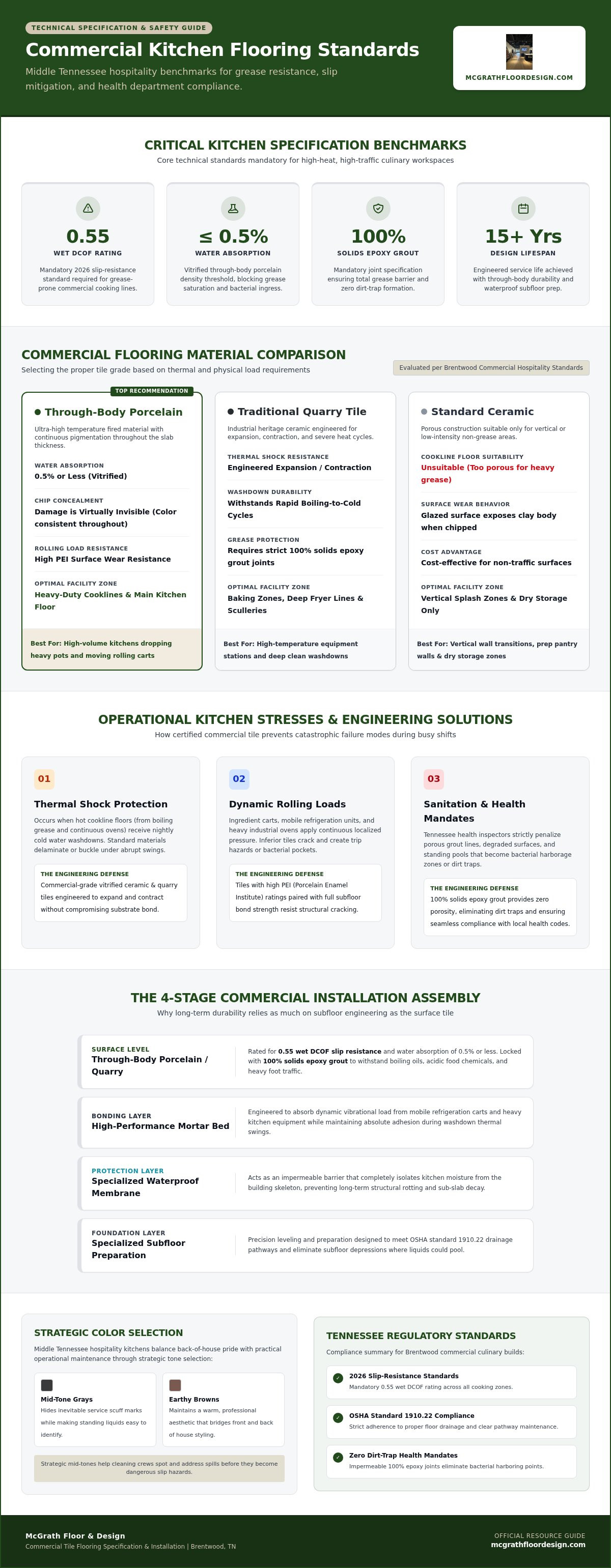
Selecting the right material for your kitchen is where engineering meets aesthetics. While residential projects often prioritize color and pattern, commercial tile flooring in Brentwood requires a deep understanding of density and vitrification. Porcelain and ceramic may look similar on the surface, but their performance in a high-heat, high-moisture environment is worlds apart. Porcelain is fired at much higher temperatures, resulting in a vitrified material with a water absorption rate of 0.5% or less. This makes it nearly impervious to the grease and bacterial growth that can plague less dense materials.
Standard ceramic tile is often too porous for heavy-duty cooklines, though it remains an excellent, cost-effective choice for vertical splash zones or dry storage areas. For the floor itself, the "through-body" nature of commercial porcelain is a major advantage. Unlike glazed tiles where the color is only on the surface, through-body porcelain carries its pigment throughout the entire slab. If a heavy stockpot is dropped and chips the tile, the damage is virtually invisible because the color remains consistent. Maintaining clear paths and proper drainage is also mandated by OSHA walking-working surface standards, and your choice of tile size plays a pivotal role in this compliance. Smaller tiles or mosaics provide more grout lines for traction, while larger formats require expert installation to ensure they slope correctly toward floor drains.
Porcelain Tile: The Modern Standard for Brentwood
Porcelain has become the preferred choice for Brentwood restaurateurs who refuse to compromise on style or safety. Its non-porous surface means that harsh chemicals and acidic food spills won't stain or degrade the tile over time. This density also makes maintenance significantly easier; a simple daily washdown is usually enough to keep the surface pristine. Beyond its technical merits, porcelain offers incredible design versatility. It can mimic the look of natural stone or sleek concrete, allowing you to maintain a high-end brand image even in the back-of-house. Our team can help you explore curated ceramic and porcelain options that fit your specific layout and aesthetic goals.
Quarry Tile: The Traditional Workhorse
For decades, the 6"x6" unglazed red quarry tile has been the industry standard for high-volume kitchens. Its natural, abrasive texture provides exceptional slip resistance, even when the floor is covered in fryer grease or water. Because it's extruded rather than pressed, it's incredibly durable and resistant to the thermal shock mentioned in the previous section. While it lacks the vast design options of modern porcelain, its cost-effectiveness and proven track record make it a reliable choice for large-scale operations. If your priority is a rugged, utilitarian floor that meets every health code requirement without breaking the budget, quarry tile remains a formidable contender.
Navigating Safety Standards: Slip Resistance and Health Code Compliance
Safety in a professional kitchen isn't just about avoiding accidents; it's about protecting your business from regulatory and legal repercussions. In Brentwood, where health inspections are rigorous, your choice of commercial tile flooring Brentwood must align with precise technical benchmarks that go far beyond residential expectations. One of the most misunderstood metrics is the Dynamic Coefficient of Friction (DCOF). Dynamic Coefficient of Friction (DCOF) is the measurement of a tile's slip resistance while a person is in motion across the surface, and for wet commercial kitchen environments, a minimum rating of 0.55 is the mandatory target to ensure safety around fry stations and cooklines.
Beyond DCOF, your facility must adhere to ADA standards to provide a safe, accessible environment for all staff members. National Sanitation Foundation (NSF) standards also play a role, ensuring that the materials you select won't harbor pathogens or degrade under the stress of a professional kitchen. These standards provide a framework for a workspace that's as safe as it is efficient. When you prioritize these ratings during the procurement phase, you're building a foundation of reliability that protects your employees and your reputation.
Tennessee Health Department Flooring Guidelines
The Williamson County Health Department follows the FDA Food Code, which mandates that floors in food prep areas be smooth, durable, and non-absorbent. A critical requirement often missed is the coved base. This creates a seamless, radiused transition between the floor and the wall, eliminating 90-degree corners where grease and bacteria accumulate. Proper drainage is equally vital. Your installation team must ensure a precise slope toward floor drains, typically 1/8" to 1/4" per linear foot, to prevent standing water. This precision is non-negotiable for passing inspections and maintaining a sanitary environment.
Choosing floors that withstand aggressive chemical cleaners is also essential. In Tennessee, sanitation protocols often require enzymatic cleaners that break down animal fats and proteins. Your tile and grout must be chemically resistant to prevent pitting or erosion over time. This ensures that your cleaning efforts are effective and that the floor doesn't become a liability as it ages.
Reducing Liability with High-Traction Surfaces
Slip-and-fall accidents are a leading cause of workplace injuries in the hospitality industry, often resulting in significant workers' compensation claims and lost productivity. High-traction surfaces are your first line of defense. Modern commercial tile flooring Brentwood utilizes advanced textured finishes that provide exceptional grip without the deep crevices that trap dirt. It's a delicate balance. If the texture is too aggressive, the floor becomes impossible to clean; if it's too smooth, it becomes a skating rink when wet.
Proactive maintenance is key to preserving these safety features. Over time, grease buildup can "fill in" the texture of a slip-resistant tile, rendering it useless. Implementing a rigorous cleaning schedule with the correct degreasers ensures that the floor's original slip-resistant properties remain intact. This proactive approach doesn't just keep you compliant; it demonstrates a commitment to your team's well-being that pays dividends in staff retention and peace of mind.
A Step-by-Step Guide to Commercial Tile Installation
The installation of commercial tile flooring in Brentwood is a technical orchestration that goes far beyond simply laying pieces of ceramic or porcelain. It's about building a system that can withstand the rigors of a 2026 culinary environment. A successful project begins with a "listen-first" mentality, ensuring we understand the specific flow of your kitchen before the first tile is set. We focus on a methodical timeline that respects your operational needs, often utilizing phased installations to keep your business running while we work. This proactive approach ensures a seamless transition from your current floor to a high-performance surface.
The Importance of Professional Subfloor Leveling
A long-lasting floor starts with the concrete slab. We meticulously identify and correct moisture issues within the substrate, as trapped vapor can cause the bond between the tile and floor to fail. Precision leveling is also the only way to ensure perfect drainage. Without a flat, properly sloped surface, you'll face standing water and bacterial growth that can lead to health code violations. Improper leveling doesn't just cause pooling; it creates "lippage," where tile edges are uneven. Under the weight of heavy industrial equipment, these uneven edges are prone to cracking and chipping, compromising the entire floor's integrity.
Epoxy Grout vs. Cementitious Grout
Standard cementitious grout is the "Achilles' heel" of many professional kitchens. Because it's porous, it absorbs animal fats, fryer grease, and harsh cleaning chemicals, leading to rapid degradation and foul odors. We specify 100% solids epoxy grout for every high-impact zone. Unlike cement-based options, epoxy is completely non-porous and stain-resistant. It creates a structural bond that is impervious to the acids found in citrus and tomatoes. While the initial material cost is higher, the long-term savings are significant. You'll spend far less on regrouting and professional deep cleaning over the floor's 15-year lifespan.
For businesses in multi-story Brentwood buildings, we integrate high-performance waterproof membranes. These elastomeric layers isolate the tile from slab shrinkage cracks and prevent moisture from migrating to the floors below. This level of protection is essential for avoiding catastrophic structural damage and neighboring business disputes. Every step of our process is designed to ensure your floor remains a high-performing asset rather than a maintenance burden. If you're ready to start your renovation, contact our specialized commercial team to discuss your project timeline.
Partnering with McGrath Floor & Design for Your Brentwood Business
Choosing a partner for commercial tile flooring in Brentwood is a decision that impacts your operational safety and brand reputation for years to come. At McGrath Floor & Design, we don't just supply materials; we act as your dedicated guide through the complex procurement process. Our team brings 50 years of combined industry experience to every project, providing the seasoned insight necessary to handle the unique demands of a professional kitchen. We believe in a "vision-to-reality" approach that begins with your specific goals and concludes with a floor that stands the test of time.
Our curated selection of premium ceramic and porcelain materials is chosen specifically for its durability and aesthetic appeal. We understand that a kitchen floor must be a high-performing tool first, but it should also reflect the quality of your brand. By focusing on high-PEI rated materials and advanced slip-resistance technologies, we ensure your facility remains compliant and safe without sacrificing style. This commitment to excellence has made us a trusted name for restaurateurs who value reliability and meticulous craftsmanship.
Local Expertise in Brentwood and Franklin
We are deeply rooted in the Middle Tennessee community, which gives us a unique understanding of the architectural and business trends specific to our area. Whether you are launching a new concept in the heart of Brentwood or refreshing an established venue, we provide MC Flooring: Premier Flooring Installation in Franklin, TN that meets local expectations. We know the Williamson County building codes and health department standards inside and out, allowing us to anticipate challenges before they arise. Our goal is to provide a seamless experience that respects your timeline and minimizes business interruptions.
Schedule Your Commercial Consultation
Your journey toward a safer, more durable kitchen begins with a professional flooring assessment. During this consultation, we evaluate your current substrate, identify potential drainage issues, and recommend the best material for your specific cooking zones. We provide accurate, transparent project timelines so you can plan your renovation with confidence. For those looking at the broader regional landscape, our Commercial Flooring: 2026 Guide for Nashville Businesses offers additional insights into the standards shaping the modern Tennessee workspace.
We invite you to experience the McGrath Advantage firsthand. From the initial measurement to the final grout line, we are committed to getting things right the first time. Our specialized installation team is ready to help you build a foundation that supports your team and your business goals. Contact McGrath Floor & Design today to start your kitchen transformation.
Build a Foundation for Your Culinary Future
Your kitchen floor is the most critical tool in your facility. It dictates the safety of your staff and the speed of your service. By mastering the technical requirements of modern materials and the latest 2026 slip-resistance standards, you're doing more than just passing an inspection. You're investing in a workspace that resists grease, bacteria, and the heavy loads of a high-volume kitchen. Selecting the right commercial tile flooring Brentwood is the first step toward a facility that performs as well as your menu.
At McGrath Floor & Design, we bring over 50 years of combined industry experience to every project. We are locally owned and operated in Middle Tennessee, and we pride ourselves on a collaborative process that prioritizes your unique vision. Our team follows high-level, NWFA-influenced installation standards to ensure every project is executed with master-level precision. When you're ready to secure the future of your business, we're here to act as your dedicated guide. Request a Commercial Flooring Consultation today to start your transformation with a partner you can trust.
Frequently Asked Questions
What is the best tile for a commercial kitchen?
Porcelain and quarry tile are the premier choices for professional culinary environments. Porcelain offers unmatched moisture resistance with an absorption rate below 0.5%, which prevents deep staining. Quarry tile is a rugged, cost-effective alternative known for its high heat resistance and natural traction. Both materials provide the structural density required to support heavy equipment and constant foot traffic in Brentwood's busiest kitchens.
Is porcelain better than quarry tile for restaurants?
Porcelain offers superior design flexibility and lower maintenance, while quarry tile provides a budget-friendly, high-traction surface. Porcelain's vitrified body is incredibly hard, which helps it resist chipping under the weight of industrial stockpots. Quarry tile remains a classic because it handles the intense heat of deep fryers without cracking. Your choice should balance your brand's aesthetic goals with the specific rigors of your cookline.
What is the required slip resistance (DCOF) for commercial kitchen floors?
The mandatory dynamic coefficient of friction (DCOF) for commercial kitchen floors is 0.55 or higher. This benchmark ensures the surface provides adequate grip even when covered in oils or water. Selecting commercial tile flooring Brentwood that meets this standard is the best way to protect your staff and reduce liability. We help you verify these technical ratings through official testing reports before any material is installed.
How long does a commercial tile installation take?
A typical commercial tile installation takes between three to seven days, depending on the complexity of the layout. We understand that downtime is a major concern for Brentwood business owners, so we often use phased schedules. This allows your team to continue partial operations while we address subfloor leveling and tile setting. Taking the time for proper substrate preparation ensures your floor remains a durable asset for 15 years.
Do I need to use epoxy grout in my commercial kitchen?
Yes, 100% solids epoxy grout is essential for any facility that handles animal fats and acidic ingredients. Standard cement-based grout is porous; it will eventually absorb grease and bacteria, leading to foul odors and structural rot. Epoxy grout creates a non-porous, waterproof bond that is impervious to harsh enzymatic cleaners. It's the only way to ensure your kitchen remains sanitary and passes every local health inspection.
Can I install new tile over my existing commercial floor?
We generally recommend a full tear-out rather than installing new tile over an existing floor. Adding a second layer can create dangerous height transitions and interfere with the proper slope toward floor drains. It also prevents us from inspecting the concrete slab for hidden moisture damage or cracks. A clean start ensures a perfect bond and allows us to verify that your kitchen meets all current building codes.
How do I maintain slip resistance on my kitchen tile?
Maintaining slip resistance requires a consistent cleaning schedule using professional-grade degreasers. Over time, microscopic layers of grease can fill in the texture of slip-resistant tiles, making them dangerously smooth. Regular scrubbing with enzymatic cleaners keeps the tile's grit exposed and effective at preventing falls. This proactive maintenance doesn't just keep your team safe; it also preserves the visual quality and longevity of your investment.
What flooring meets Tennessee health department codes for restaurants?
Tennessee health department codes mandate that kitchen floors must be smooth, non-absorbent, and easily cleanable. You must also include a coved base, which creates a radiused transition between the floor and the wall to eliminate dirt traps. Our team ensures that your installation includes the proper slope toward drains to prevent standing water. We focus on these details to guarantee that your facility passes every inspection with flying colors.


