
You've spent months designing the perfect Franklin kitchen, only to notice the first signs of warping near the dishwasher after a particularly humid Tennessee summer. It's a frustrating moment that many local homeowners face when their high-end finishes can't keep up with the demands of real life. Finding a truly durable floor covering isn't just about picking a pretty sample. It's about matching the right material to your specific lifestyle and our unique Middle Tennessee climate. Whether you're dealing with the energetic paws of a large dog or the moisture of a busy mudroom, your floors should be a source of pride rather than a constant worry.
We understand that a floor is one of the most significant investments you'll make in your home. It's the foundation of your daily life and the backdrop for your family's best memories. You deserve the peace of mind that comes with a floor that stays beautiful year after year. This guide will help you master the art of selecting long-lasting materials by focusing on the technical ratings and environmental stability required for our region. We'll walk you through our 2026 checklist, covering everything from Janka hardness scores to the precision installation techniques that protect your investment.
Key Takeaways
- Define durability beyond just surface hardness by considering moisture resistance and structural integrity for each room's specific demands.
- Perform a comprehensive "Home Audit" to identify high-traffic zones and environmental risks before you begin your selection process.
- Evaluate the unique benefits of hardwood, ceramic, and advanced laminate to choose the most durable floor covering for your family's needs.
- Protect your investment from Middle Tennessee's humidity by prioritizing proper material acclimation and climate-specific installation techniques.
- Ensure your flooring warranty remains valid and your home stays beautiful by pairing premium materials with expert craftsmanship.
Understanding Durability: What Actually Makes a Floor Covering Last?
True durability is a complex equation. It combines surface hardness, structural integrity, and moisture resistance into a single performance profile. Choosing a durable floor covering for your Franklin home requires looking beyond the initial finish. You have to consider how that material interacts with your daily habits and the local environment. A floor that survives a formal dining room might fail miserably in a high-traffic mudroom where wet boots and grit are the norm. We define a lasting floor as one that maintains its structural "spine" while resisting the cosmetic "scars" of a busy household.
Durability isn't a universal standard; it's room-specific. In a kitchen, your primary enemies are moisture and dropped heavy objects. In a sunroom, UV resistance and thermal expansion take priority. By 2026, the industry has bridged the gap between rugged performance and high-end aesthetics. You no longer have to sacrifice the warmth of wood for the resilience of stone. Investing in premium materials today creates significant life-cycle value. A floor that lasts thirty years is far more economical than one that requires replacement by 2036. High-quality selections offer peace of mind, ensuring your home remains a sanctuary rather than a construction zone.
The Technical Metrics of Toughness
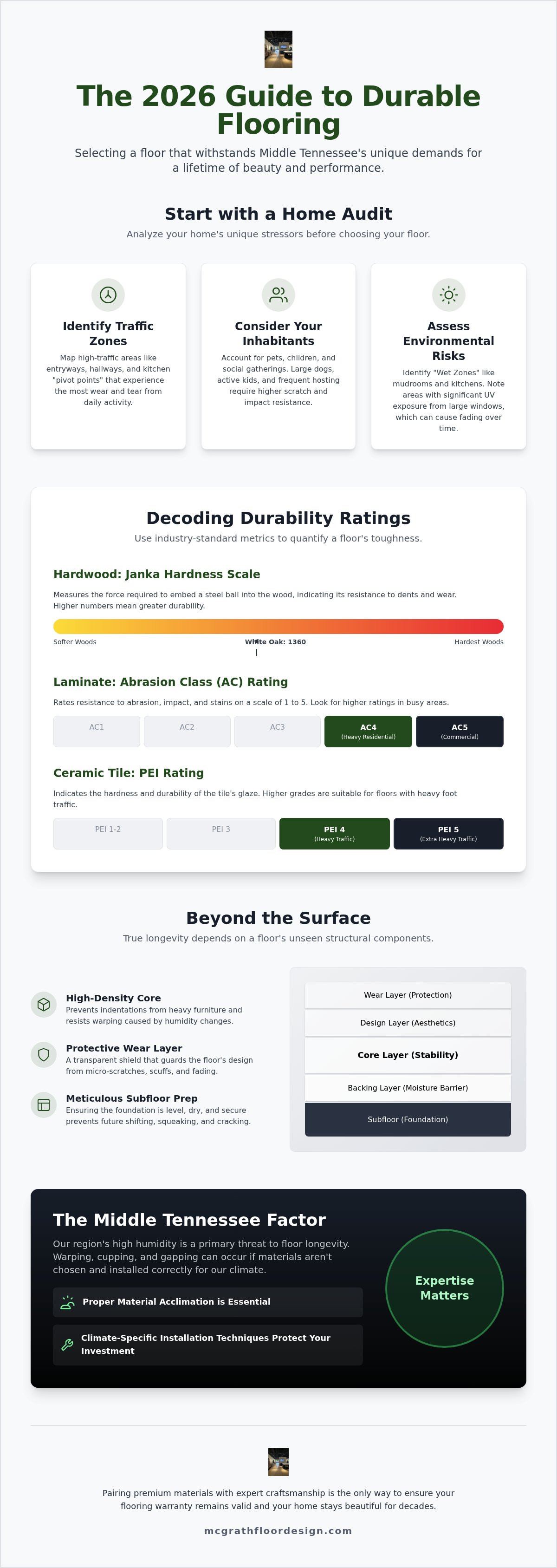
We use specific industry scales to quantify how a material will perform under pressure. For hardwood, we look at the Janka Scale. This metric measures the force required to embed a small steel ball into the wood. For instance, White Oak is a local favorite because it sits at a resilient 1,360 on the scale. When selecting laminate, pay attention to AC Ratings. An AC4 rating is robust enough for heavy residential use, while AC5 is designed for commercial-grade foot traffic. Ceramic tile uses PEI Ratings. A PEI Grade 4 or 5 ensures your kitchen floor can handle heavy traffic without the glaze wearing thin or losing its luster.
Beyond the Surface: Structural Stability
A floor's longevity often depends on what you can't see. Core density is frequently more vital than surface thickness. A dense, high-pressure core prevents indentations from heavy furniture and resists the warping effects of humidity. High-performance wear layers act as a transparent shield, protecting the design from the "micro-scratches" caused by dust and pet claws. However, even the most durable floor covering will fail without proper subfloor preparation. We ensure your foundation is level, dry, and secure. This meticulous attention to detail prevents the shifting and cracking that often plagues subpar installations.
The Pre-Purchase Checklist: Assessing Your Home’s Needs
Before you step into a Nashville showroom, take a deliberate walk through your own hallways. A systematic "Home Audit" is the most effective way to ensure you select a durable floor covering that actually fits your life. Most homeowners choose materials based on a small sample; however, true longevity is found by analyzing the specific stressors of your environment. You'll want to categorize your rooms into Traffic Zones: High, Medium, and Low. This prioritization allows you to invest heavily in the areas that take the most abuse while perhaps choosing softer options for guest bedrooms.
Consider the "Inhabitants Factor" as well. A home with a 70-pound Golden Retriever requires a different level of scratch resistance than a quiet residence for retirees. Similarly, if you frequently host large gatherings, your floors must withstand the constant friction of sliding chairs and high heels. Don't forget to look up at your windows. Large, south-facing glass in many Franklin homes invites significant UV exposure, which can cause certain materials to fade or become brittle over time. Identifying your "Wet Zones" is equally critical. In mudrooms and kitchens, moisture resistance is the non-negotiable priority that dictates your final choice.
Step 1: Identify Your Traffic Patterns
Entryways and mudrooms are the frontlines of your home's defense. In Middle Tennessee, our infamous red clay acts like sandpaper on a floor's finish if it isn't managed correctly. You need to map the main thoroughfares where your family moves most often. Pay special attention to "pivot points," such as the area in front of the refrigerator or the base of the stairs. These are the spots where people turn or stop abruptly, causing the finish to wear down faster than in the center of a room. Selecting a material that can handle this localized friction is the key to a floor that looks uniform for decades.
Step 2: Account for Environmental Variables
Middle Tennessee's climate presents unique challenges that can undermine even the most durable floor covering if ignored. If you live in Brentwood or Franklin, your home likely sits over a crawlspace or a basement where humidity levels fluctuate wildly. This moisture can travel through the subfloor, causing wood to cup or laminate to peak. You must also determine if your subfloor is concrete or wood. This technical detail limits your material options and dictates the type of moisture barrier required. If you're unsure how to evaluate these factors, speaking with a local specialist can help clarify which materials are structurally compatible with your home's foundation.
Material Showdown: Comparing the Most Durable Floor Coverings
Every home has a unique rhythm, and your choice of material should reflect how you live within your walls. While some homeowners prioritize the heritage and warmth of natural wood, others require the impervious nature of stone or the rugged resilience of modern composites. Choosing a durable floor covering means balancing immediate performance with long-term repairability. In 2026, the lines between these categories have blurred, as manufacturing advances allow for high-performance materials that mimic natural textures with startling accuracy. Your decision ultimately rests on whether you value a surface that can be refinished over decades or one that offers maximum resistance to the chaos of a busy household.
Hardwood: The Timeless Choice
Investing in hardwood flooring remains one of the most effective ways to increase your home's long-term property value. However, durability in the Tennessee climate requires a strategic approach. We typically guide our clients toward engineered hardwood rather than solid planks. The cross-grain construction of engineered cores provides superior stability against the expansion and contraction cycles common in Franklin. To maximize dent resistance, we recommend selecting high-Janka species. Hickory and White Oak are excellent local choices. Hickory, with its impressive 1820 Janka rating, is particularly adept at handling the heavy foot traffic and active pets found in many Middle Tennessee homes. The primary advantage here is longevity; a high-quality hardwood floor can be sanded and refinished multiple times, allowing it to evolve with your home's style for generations.
Laminate and Ceramic: The Performance Leaders
If your primary concern is surface scratches and moisture, the 2026 evolution of laminate flooring offers a compelling solution. Modern high-pressure laminate (HPL) is widely considered the king of scratch resistance. It utilizes a dense wear layer that shrugs off the grit and red clay that often find their way into our homes. For those seeking a truly waterproof durable floor covering, ceramic and porcelain remain the undisputed champions. These materials are ideal for Brentwood mudrooms and kitchens because they are non-porous and chemically inert. We've seen a shift toward large-format porcelain tiles that offer incredible aesthetic versatility, from sleek contemporary finishes to convincing wood-look textures. Modern grout technology has also improved significantly. High-performance, stain-resistant grouts ensure that your tile installation remains pristine without the heavy maintenance schedules of the past. While these materials are harder to "repair" than wood, their sheer resistance to daily wear makes them a favorite for high-impact zones.
The Middle Tennessee Factor: Humidity and Your Floor’s Lifespan
Middle Tennessee experiences a dramatic shift in relative humidity between the sweltering summers and the crisp, dry winters. This "Nashville Humidity Cycle" acts like a lung for wood-based materials, forcing them to inhale moisture in July and exhale it in January. If your durable floor covering isn't prepared for this constant movement, you'll eventually see unsightly gaps, annoying squeaks, or even structural buckling. Understanding how local climate affects your material choice is what separates a successful renovation from a costly mistake. Ceramic is naturally moisture-stable, while solid hardwood remains highly moisture-sensitive. To protect your investment, we recommend keeping your home's relative humidity between 35% and 55% year-round using your HVAC system or a dedicated dehumidifier.
Acclimation is the most critical, yet frequently skipped, step in the installation process. This is the period where your new flooring sits in your home to reach "equilibrium moisture content" before it's ever nailed or glued down. We insist on letting materials rest in your specific environment for several days. This patience ensures the material has already done its initial expanding or contracting before it's locked into place. Rushing this stage is the primary cause of floor failure in Franklin and Brentwood homes. To ensure your selection is perfectly matched to your home's unique environment, contact our team for a professional assessment of your space.
Why Engineered Wood Wins in Nashville
While traditional solid hardwood has a certain heritage, engineered wood is often the superior choice for our regional climate. Its multi-layered, cross-grain construction creates a structural tension that resists the natural tendency of wood to warp or twist. When the top layer wants to move, the layers beneath it hold it firmly in place. This engineered stability is why these floors stay flat even during our most humid months. The plywood or high-density fiberboard cores in engineered products create a tension that prevents the edges of the boards from rising, a phenomenon known as "cupping," which is common in Brentwood homes with high crawlspace moisture.
Selecting Humidity-Proof Laminate
Modern laminate has come a long way, but you must choose the right specifications for a durable floor covering that lasts. Look specifically for products featuring wax-infused edges and high-density, water-resistant cores. These technical details prevent liquid from seeping into the tongue-and-groove joints, which is where most moisture damage begins. We also pay close attention to expansion gaps during installation. These precise spaces at the perimeter of your room allow the entire floor to "breathe" and move as a single unit without hitting the walls and buckling. Finally, a high-quality underlayment is essential. It acts as a dedicated moisture barrier, protecting your floor from any dampness rising through the subfloor.
From Selection to Installation: The McGrath Craftsmanship Difference
You've done the research and identified the perfect materials for your home. However, the journey to a beautiful floor doesn't end at the checkout counter. Even the most durable floor covering can fail prematurely if the installation isn't handled with surgical precision. Many homeowners don't realize that manufacturer warranties are often conditional, requiring specific moisture testing, subfloor leveling, and exact expansion gaps to remain valid. At McGrath Floor & Design, we bridge the gap between high-quality materials and long-term performance through our "Vision-to-Reality" process. We treat your home with the same respect we'd give our own, ensuring every plank and tile is positioned for a lifetime of use.
The true value of professional installation lies in the details that are invisible to the untrained eye. We don't just "lay" a floor; we engineer an environment where that floor can thrive. This involves a meticulous assessment of your home's foundation and humidity levels, as we discussed in previous sections. By choosing a partner with over 50 years of combined industry experience, you're investing in a legacy of craftsmanship that prioritizes reliability over speed. We're here to guide you through every technical hurdle, ensuring your investment stays as stunning in a decade as it is on the day of completion.
The Role of Expert Guidance
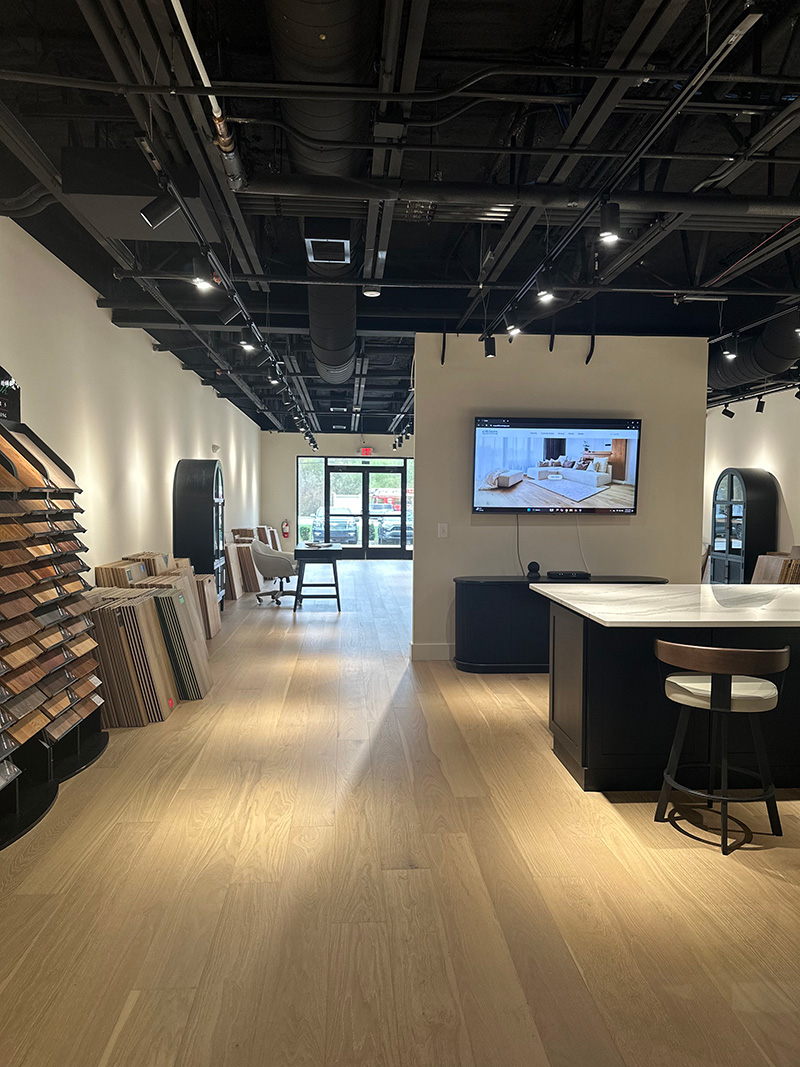
Visiting our showroom in the Franklin and Brentwood area offers a distinct advantage over wandering through the aisles of a big-box warehouse. Instead of generic stock, you receive personalized attention from experts who understand the specific environmental challenges of Middle Tennessee. We help you navigate our 2026 checklist to find a match that suits your aesthetic and your lifestyle. Seeing large-scale samples allows you to touch the textures and see how colors react to local light. This hands-on experience is vital. It ensures your choice isn't just a guess based on a tiny swatch, but a confident decision backed by professional insight into your specific subfloor and household needs.
Precision Installation: The Final Step in Durability
Longevity is built from the ground up. We adhere to NWFA-level standards for every hardwood project, which means we never take shortcuts on moisture barriers or fastening patterns. Our master craftsmen are dedicated to getting it right the first time to avoid the frustration of future repairs or structural issues. We understand that a home renovation can be disruptive, so our methodical approach ensures a smooth, predictable transition from your old floors to your new reality. By choosing professional installation, you're securing the peace of mind that your durable floor covering is protected by the highest standards in the trade. We invite you to schedule a consultation at our Franklin showroom today to begin your home's transformation.
Secure Your Home’s Foundation for the Future
Selecting a durable floor covering is about more than just surviving the present; it's about ensuring your home remains a source of pride for decades. By now, you understand that true longevity requires a trifecta of the right material, a deep understanding of our local humidity, and the precision of a master craftsman. Whether you prioritize the timeless appeal of engineered hardwood or the impervious nature of ceramic, your choice should reflect both your personal style and the functional realities of your household traffic.
With over 50 years of combined industry expertise, our team is uniquely equipped to help you navigate these technical decisions. We specialize in solving the specific climate challenges found in Franklin and Brentwood homes, offering a curated selection of high-performance materials designed to last. We invite you to visit our Franklin showroom to touch and test our most durable flooring collections. Let's work together to turn your vision into a stunning reality that stands the test of time. Your dream home deserves a foundation that's as resilient as it is beautiful.
Frequently Asked Questions
What is the most durable floor covering for homes with large dogs?
Ceramic tile is the most resilient option for homes with large dogs because its hardened surface is virtually impervious to claws. If you prefer the look of wood, high-pressure laminate with an AC4 or AC5 rating provides excellent scratch resistance that holds up against energetic paws. These materials ensure your home stays beautiful without the constant worry of deep gouges or finish wear.
Is laminate or hardwood more durable for a high-traffic kitchen?
Laminate is generally more durable than hardwood for a high-traffic kitchen due to its superior resistance to moisture and topical scratches. While hardwood offers timeless beauty, it's more susceptible to damage from dropped pots or standing water. For a truly worry-free kitchen, ceramic remains the top recommendation because it handles heavy spills and frequent cleaning without compromising its structural integrity.
How does Tennessee humidity affect my choice of durable flooring?
Middle Tennessee's humidity makes moisture-stable materials like ceramic or engineered hardwood the smartest choices for local homes. Traditional solid hardwood often struggles with the Nashville humidity cycle, leading to cupping or gapping over time. Selecting a durable floor covering that's designed to handle expansion and contraction ensures your investment remains flat and secure regardless of the season.
What is the difference between scratch-resistant and scratch-proof flooring?
No flooring material is truly scratch-proof, but many modern options are highly scratch-resistant. Scratch-resistance refers to a floor's ability to withstand daily friction from dust, shoes, and pet movement. However, extreme force, like sliding a heavy refrigerator without protection, can still damage any surface. Understanding this distinction helps you set realistic expectations for your floor's long-term appearance.
Does professional installation really make a floor more durable?
Professional installation is essential because it guarantees that a durable floor covering is fitted to the specific requirements of your subfloor. Our team ensures proper acclimation and precise expansion gaps, which are the primary factors in preventing buckling and peaking. Without expert oversight, even the most expensive materials can fail prematurely due to environmental stressors or improper foundation preparation.
What are the easiest durable floors to maintain in 2026?
Ceramic tile and high-pressure laminate are the easiest floors to maintain in 2026. These surfaces don't require the periodic sanding or specialized waxing that natural wood often needs to stay pristine. A simple routine of regular sweeping and occasional damp mopping is usually enough to keep these materials looking brand new for years. This ease of care makes them a favorite for busy Franklin families.
Can ceramic tile crack in high-traffic areas?
Ceramic tile won't crack from heavy foot traffic if the subfloor is properly prepared and leveled. Most cracks are the result of structural movement in the subfloor or voids in the mortar beneath the tile. When our master craftsmen install your tile, we focus on creating a perfectly flat, stable foundation. This meticulous process ensures your floor handles any amount of traffic without compromising the material.
Is engineered hardwood as durable as solid hardwood?
Engineered hardwood is often more durable than solid hardwood in our specific climate because its layered construction resists warping. While solid wood can be refinished more times over a century, engineered planks provide better stability against the humidity shifts common in Brentwood. This structural advantage makes engineered wood a more reliable choice for maintaining a flat, beautiful surface in Tennessee homes.


