
Waiting just 24 hours is usually too short for hardwood to acclimate. For hardwood floor acclimation in Brentwood, allow most floors 3 to 10 days in normal indoor living conditions before installation; some exotic species may need up to 14 days. The right wait depends on the wood, the home’s environment, and how closely the flooring’s moisture content matches the subfloor.
It makes sense to want a clear installation date, especially during a renovation. But hardwood floor acclimation in Brentwood isn’t just a matter of leaving boards in a room for a set number of days. Stable indoor conditions and appropriate moisture readings matter, too. This guide explains how to prepare your home, store solid hardwood, and determine when it’s ready for installation. It also covers why solid flooring may need more time than expected and which conditions can affect the timeline.
Key Takeaways
- Prepare steady indoor conditions before delivery, and use moisture balance, not the calendar alone, to judge readiness.
- For engineered wood, follow the product’s acclimation instructions and keep indoor humidity conditions stable.
- Compare flooring and subfloor moisture readings before installation; plank width affects how close those readings should be.
- Plan solid hardwood acclimation around the wood species and the home’s conditions, then learn what signs indicate it’s ready.
Hardwood Floor Acclimation: How Long to Wait Before Installation?
Treat acclimation as moisture conditioning, not a fixed calendar pause. Most hardwood needs 3 to 10 days under normal indoor conditions. In Brentwood, follow applicable local building requirements and the flooring manufacturer’s installation guidelines. Manufacturer instructions determine the acclimation steps for each product.
-
Prepare Indoor Conditions Before Delivery
Stabilize the home for 48 to 72 hours before flooring delivery. Close the building envelope, complete wet work, and let interior conditions settle before bringing boards inside. Keep the flooring out of rooms where conditions are changing quickly. This preparation gives hardwood a more consistent environment for adjusting its moisture content after arrival.
-
Run Heating and Air Conditioning
Run your permanent heating or air-conditioning system for at least five days before installation. Don’t rely on temporary heaters or fans to create a short-lived change in the room’s climate. Keep the system running during acclimation as well. Seasonal temperature shifts can affect indoor moisture conditions, so avoid turning the system off while the flooring adjusts.
-
Establish and Maintain Normal Indoor Conditions
Maintain building relative humidity between 30 and 50 percent year-round for optimal wood flooring performance. Keep the home at its normal living climate during acclimation, rather than opening windows or changing settings to speed the process. Stable conditions help flooring and subfloor moisture move toward balance. Engineered hardwood may have different product guidelines, so use its specific instructions.
-
Check Applicable Installation Requirements
Read the manufacturer’s installation instructions before opening packages or starting acclimation. Check the required indoor climate, package handling, and moisture conditions for the selected flooring. Apply relevant local building requirements to the installation, rather than assuming every product follows identical steps. A 24-hour wait is usually insufficient; use moisture readiness and the product guidelines to determine when installation can proceed.
Do you need to acclimate engineered wood flooring?
Engineered hardwood often needs 48-72 hours under normal indoor living conditions, but the product instructions set the process. Use humidity readings and packaging guidance, not a fixed assumption, to plan installation.
-
Compare Solid and Engineered Acclimation Needs
Check the instructions for your exact flooring before preparing the boards. CALI recommends acclimating solid hardwood out of its box in a sticker-stack pattern, while engineered hardwood can acclimate in its box. This difference affects airflow and handling. Some hardwood products don’t require acclimation, and ignoring the manufacturer’s instructions may void warranty coverage.
-
Account for Humidity
Measure indoor relative humidity before the shipment arrives, then keep conditions steady during acclimation. A recommended monitoring range before receiving wood flooring is 35 to 60 percent relative humidity. Some engineered-flooring manufacturers require job-site humidity between 30 and 50 percent for warranty coverage. These ranges serve different purposes, so follow the specific product’s requirements instead of treating one range as universal.
-
Determine Acclimation Duration
Allow engineered hardwood 48-72 hours under normal indoor living conditions as a general estimate. If the manufacturer requires acclimation, three days is a useful rule of thumb, but product instructions govern the actual schedule. Keep cartons inside an enclosed building, not a garage or exterior patio. For help comparing materials and planning a flooring choice, explore hardwood flooring options.
At least three days if advised; use a moisture meter immediately on delivery. Acclimation may be unnecessary at geographic baseline with recommended humidity maintained; Mountain West and Southwest often have indoor air moisture ranges of 4-7%.
Moisture-content differences between flooring and subfloor
Compare moisture readings before installation, since wood flooring responds to moisture changes after it is laid. Board width affects the acceptable difference, so assess readings alongside the flooring specifications and room conditions.
-
Measure Flooring and Subfloor Moisture
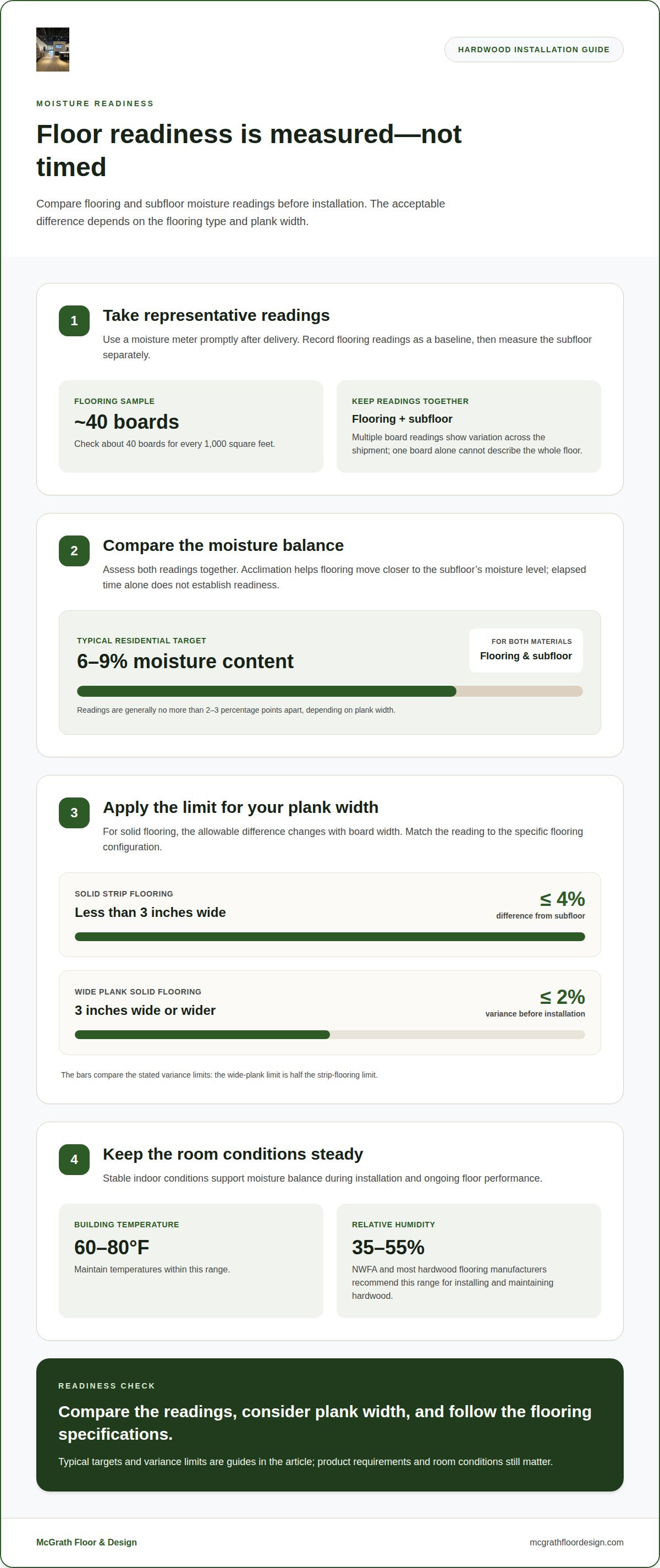
Measure the flooring promptly after delivery and record the readings as a baseline. Check about 40 boards for every 1,000 square feet, then measure the subfloor separately. Sampling multiple boards shows whether moisture content varies across the shipment. Keep the results together; a single board reading cannot describe the entire floor or establish its balance with the subfloor.
-
Test the Moisture Balance
Compare the flooring and subfloor readings, not just each number in isolation. Typical residential targets for both materials are 6-9 percent moisture content, with readings generally no more than 2-3 percent apart, depending on plank width. Acclimation helps bring the wood flooring closer to the subfloor’s moisture level. A matching trend matters more than elapsed time alone.
-
Compare Moisture-Content Differences
Match the allowable difference to the board type and width. Solid strip flooring less than 3 inches wide should be no more than 4 percent different from the subfloor. Wide plank solid flooring 3 inches or wider should have no more than a 2 percent variance before installation. These thresholds show why one general reading cannot determine readiness for every floor.
-
Check Temperature and Humidity Targets
Maintain building temperatures between 60 and 80 degrees Fahrenheit, and keep humidity within the product’s recommended range. The NWFA and most hardwood flooring manufacturers recommend 35 to 55 percent relative humidity for installing and maintaining hardwood. Stable living conditions support consistent moisture content; avoid changing the climate sharply during construction. Readings and board width together help identify potential movement problems.
Solid hardwood acclimation duration
Plan for 3 to 10 days for most solid hardwood under normal indoor living conditions. That’s a starting range, not a substitute for checking the wood, home conditions, and installation instructions.
- Start with the flooring instructions. Check the product’s acclimation requirements before setting an installation date. Some hardwood products don’t require acclimation; others call for a specific process. Follow the instructions for the exact material, including how to stack the planks and when to take moisture readings. A calendar estimate alone can’t tell you whether the wood has adjusted to your home.
- Use the usual range as a planning guide. Most solid hardwood needs 3 to 10 days to acclimate, depending on the species, flooring, and indoor conditions. Site-finished wood flooring may need 5 to 7 days before installation. These schedules vary because boards respond to the moisture conditions around them. Keep the home’s normal living climate steady while the planks adjust.
- Allow more time when the wood or climate calls for it. Exotic wood species may need up to 14 days. Tropical species typically require more time, and their natural resins and oils can make moisture-content readings difficult to interpret. Solid fossilized flooring may need 10 days or longer in especially dry or humid regions. Use the product’s instructions and readings to guide the schedule.
- Use moisture readings to judge readiness. Acclimation aims to bring flooring moisture content close to the subfloor, supporting equilibrium and limiting later movement. Don’t treat the final day in a time estimate as automatic approval for installation. Compare readings with the product’s requirements and account for plank width and room conditions. For help choosing hardwood flooring for your home, explore the available options.
McGrath Floor & Design: Hardwood Flooring
McGrath Floor & Design can help you coordinate acclimation planning with your hardwood flooring selection. If you’re comparing solid and engineered materials, the team can guide you through product selection and installation, taking your project and home conditions into account. This discussion can help before you set an installation schedule, particularly if you’re also considering laminate or ceramic flooring.
Bring your priorities and questions about the space, and discuss which flooring direction suits the look and practical needs of your home. For a personal next step, contact McGrath Floor & Design or visit mcgrathfloordesign.com.
Plan Your Flooring Project With Confidence
Make your next step a considered flooring choice, not simply a target installation date. For hardwood floor acclimation in Brentwood, consider how each room is used, the look you want, and the conditions in your home. This gives you a clearer basis for discussing materials and planning the work around your renovation.
McGrath Floor & Design offers hardwood, laminate, and ceramic flooring, with guidance through product selection and installation. Share your goals and which spaces you’re updating to start shaping a plan around your home and design priorities.
Start a flooring conversation with McGrath Floor & Design, and take the next step toward a home that feels thoughtfully finished.
Frequently Asked Questions
What is Acclimation?
Acclimation allows wood flooring to adjust its moisture content to the indoor environment. Wood responds to changes in the surrounding climate, so the aim is to reduce the difference between the boards and subfloor before installation. Flooring delivered into a home with different conditions from its storage environment, for example, may need time to adjust. Follow the product instructions for the process.
Where does excessive moisture come from?
Excess moisture can come from crawl-space vapor, plumbing leaks, wet construction, or humid indoor air. A damp crawl space can allow moisture vapor to enter the home and affect wood below. In a home built over a crawl space, covering the ground with 6 mil black plastic can help limit that vapor. Address moisture sources before flooring arrives, rather than relying on acclimation to correct them.
How long should hardwood flooring acclimate before installation in Brentwood?
For hardwood floor acclimation in Brentwood, most hardwood takes 3 to 10 days under normal indoor conditions. The wood species, home environment, and product instructions influence the schedule. Exotic species may require up to 14 days, while site-finished flooring may need 5 to 7 days. Treat these durations as planning guidance, then assess moisture readings and the specific manufacturer’s installation instructions.
What temperature and humidity should a home maintain during hardwood floor acclimation?
Maintain a building temperature between 60 and 80 degrees Fahrenheit, with relative humidity in the range recommended for the flooring. The NWFA and most hardwood flooring manufacturers recommend 35 to 55 percent relative humidity for installing and maintaining hardwood. Keep the home’s normal heating or air-conditioning pattern steady, including through seasonal changes, rather than making abrupt adjustments to influence readings.
Does hardwood flooring need to acclimate in its packaging or opened in the room?
Follow the product instructions because solid and engineered flooring may have different packaging requirements. CALI recommends acclimating solid hardwood out of its box in a sticker-stack pattern, while engineered hardwood can acclimate in its box. Opening packages and dividing the shipment into smaller lots increases airflow. Store flooring inside an enclosed building, not in a garage or on an exterior patio.
How do you measure hardwood moisture content before installation?
Use a moisture meter to record flooring readings immediately after delivery, creating a baseline for comparison. Check about 40 boards for every 1,000 square feet, then measure the subfloor and compare the results. Record readings across the shipment rather than relying on one plank. Board width affects the acceptable difference, so use the flooring instructions to interpret the comparison before installation.


