
In Middle Tennessee, your home's foundation is constantly at war with the very air around it. Nashville homeowners know the heavy, liquid feeling of a July morning when the humidity peaks at 80 percent. While this moisture fuels our lush landscapes, it presents a silent challenge to the structural integrity of your home. You've likely felt the frustration of boards that swell and buckle during a muggy summer or seen unsightly gaps appear the moment the winter chill arrives. It's a common struggle, but your floors don't have to be at the mercy of the seasons.
By following specific hardwood floor maintenance tips Nashville experts trust, you can transform your living space into a stable sanctuary. We're here to share the professional strategies used to maintain the 35 to 55 percent relative humidity range recommended by the National Wood Flooring Association. This guide will walk you through a clear cleaning schedule, the secrets of climate control, and the exact products that protect your finish rather than stripping it away. You'll gain the confidence to enjoy your investment, knowing your floors are prepared to handle whatever the Tennessee weather decides to do next.
Key Takeaways
- Learn to identify early visual warnings like cupping and crowning before moisture stress causes permanent damage to your planks.
- Discover why engineered hardwood's multi-ply construction offers a distinct advantage over solid wood in Middle Tennessee's subtropical climate.
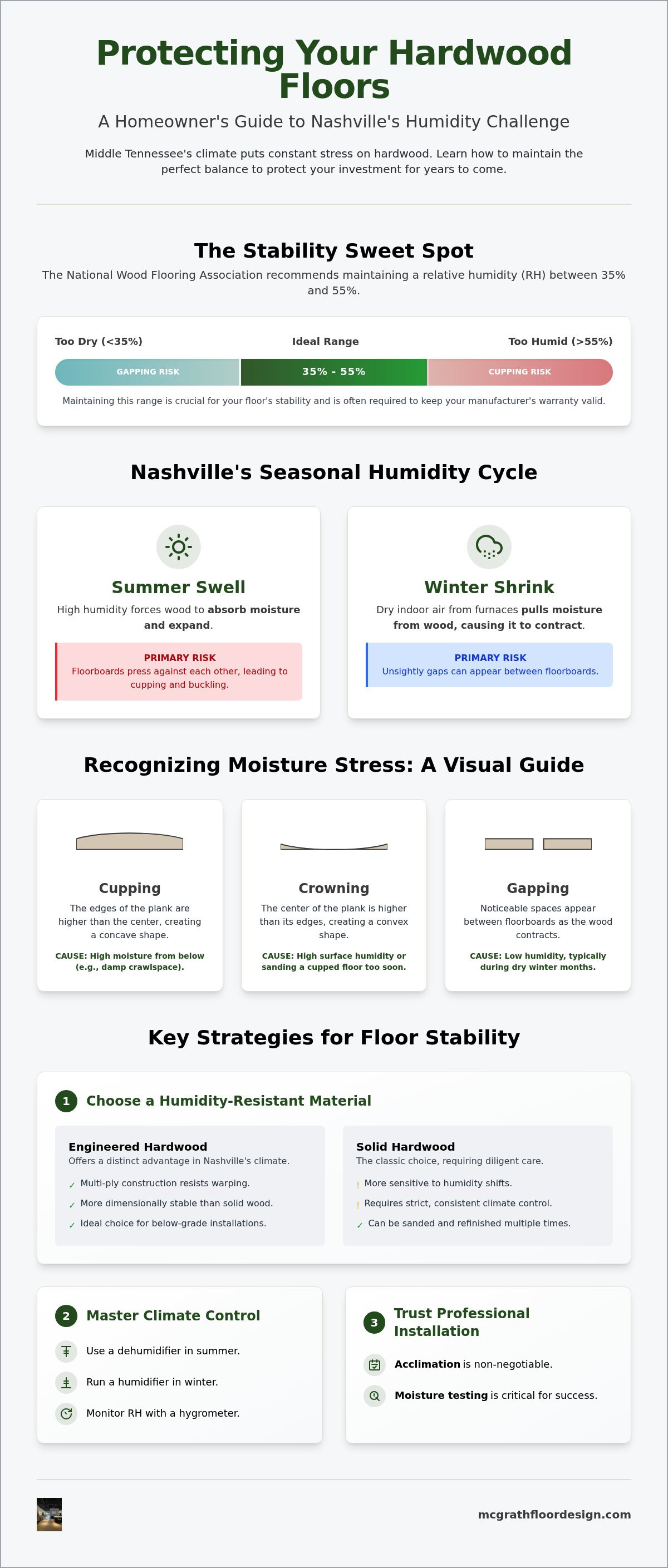
- Master the essential hardwood floor maintenance tips Nashville professionals recommend for keeping your home within the ideal 35% to 55% relative humidity range.
- Understand the technical importance of the acclimation process and why moisture testing is a non-negotiable step for any successful installation.
The Middle Tennessee Humidity Cycle: Why Nashville Homes Are Unique
Nashville's climate is technically classified as humid subtropical. This means our summers aren't just hot; they're saturated. When outdoor humidity levels consistently exceed 70 percent, your home acts like a vacuum for moisture. This is why generic hardwood floor maintenance tips Nashville homeowners find online often fail. They don't account for the aggressive "vapor drive" that pushes humid air from the outdoors into your climate-controlled rooms through your walls and subfloor.
Relative humidity (RH) is the amount of water vapor present in the air relative to what it could hold at that temperature. For hardwood, RH is the primary driver of wood moisture content. Wood is naturally hygroscopic. It acts like a sponge, expanding as it absorbs water and shrinking as it releases it. Without a local strategy, your floors are constantly in motion.
Summer Peaks and Winter Lows
During a typical Tennessee summer, the high moisture load causes floorboards to expand. If there isn't enough expansion space, the boards press against each other, leading to "cupping" where the edges of the planks sit higher than the center. In Brentwood homes, the winter brings the opposite challenge. Forced-air heating systems strip moisture from the air, causing boards to contract and leave unsightly gaps. Many of these issues start beneath your feet. In Middle Tennessee, the crawlspace is often the primary source of moisture. Without a proper vapor barrier or encapsulation, damp earth can saturate your subfloor, making it impossible to stabilize the wood above.
The Long-Term Cost of Moisture Neglect
Ignoring these cycles does more than hurt your home's aesthetic. Most flooring manufacturers explicitly state that their warranties are only valid if the home is maintained within a specific humidity range. If your floors fail due to environmental neglect, you're left unprotected. Equilibrium Moisture Content (EMC) is the specific point where wood neither gains nor loses moisture because it has reached a balance with the surrounding air temperature and humidity. Following professional hardwood floor maintenance tips Nashville experts recommend ensures you stay within these warranty limits. Maintaining this balance is essential for floorboard stability and your family's health. Stable floors prevent the growth of mold and dust mites, ensuring your indoor air quality remains as high as your craftsmanship standards.
Recognizing Signs of Moisture Stress in Your Floorboards
Wood behaves as a living material long after it has been milled and installed. It is naturally hygroscopic, meaning it constantly exchanges moisture with the surrounding environment. According to the USDA Wood Handbook, this relationship between wood and water is the primary cause of dimensional changes. In Nashville, where the air can be heavy with humidity one week and bone-dry the next, your floors are under constant pressure. Some species handle this better than others. White Oak, a staple in Tennessee homes, offers moderate stability. Hickory, while beautiful and incredibly hard, is much more sensitive to moisture shifts and requires more diligent care.
Cupping vs. Crowning: A Warning from Your Wood
Visual changes in your floor are often a cry for help. Cupping occurs when the edges of a plank sit higher than its center, creating a concave shape. This is usually caused by moisture rising from below, such as a damp crawlspace or a leak. Conversely, crowning happens when the center of the board is higher than the edges. This often results from high surface humidity or, more dangerously, from sanding a cupped floor before it has properly dried. If you notice your boards cupping, do not rush to refinish them. Sanding a cupped floor while it is still wet will lead to permanent crowning once the moisture levels finally stabilize.
Gapping: The Winter Reality in Brentwood
During our colder months, you might notice small spaces appearing between your floorboards. In most cases, this is a normal sign of healthy wood reacting to the dry heat of your furnace. These seasonal gaps usually close up as the humidity returns in the spring. However, if gaps are wide enough to fit a nickel or if they persist through the summer, you may be facing structural issues or subfloor failure. For a deeper look at long-term care, our Hardwood Flooring in Nashville: 2026 Homeowner’s Guide provides more detail on what to expect over the life of your floor.
Learning to read these visual signs is one of the most proactive hardwood floor maintenance tips Nashville residents can master. It allows you to address environmental issues before they require costly repairs. If you're concerned about the movement in your home, feel free to visit our Franklin showroom to speak with a master craftsman about your specific flooring species and how it reacts to the local air.
Choosing Humidity-Resistant Hardwood for Franklin Interiors
Selecting the right material is the first step in successful floor preservation. While aesthetic beauty often drives the initial decision, the physical properties of the wood determine how much work you'll have to do later. In our Franklin showroom, we often start by looking at your home's foundation. If you're building on a concrete slab, the moisture profile is vastly different than a home with a traditional plywood subfloor. Matching your wood choice to these environmental realities is one of the most effective hardwood floor maintenance tips Nashville homeowners can follow to prevent long-term warping.
Stability ratings vary significantly across different species. Oak is the gold standard for Tennessee homes because it offers a reliable balance of hardness and dimensional stability. Walnut is softer and relatively stable, but it can be prone to denting in high-traffic areas. Hickory, though incredibly hard and visually striking, is often described as a "nervous" wood. It reacts quickly and dramatically to moisture shifts, which can make it a challenging choice for the Greater Nashville area unless your climate control is impeccable.
Why Engineered Wood Wins the Stability War
For many Middle Tennessee homes, engineered hardwood is a game-changer. Unlike solid planks, which are a single piece of wood, engineered flooring features a cross-layered core. These layers are stacked with the grain running in opposing directions, which physically restricts the wood's ability to expand and contract. This design makes it significantly more resilient during our humid summers. There's a common myth that you can't refinish these floors, but high-quality options with a thick wear layer can be sanded and finished multiple times, just like solid wood. For more technical details on this process, see our Engineered Hardwood Flooring Installation in Brentwood, TN: The 2026 Homeowner’s Guide.
White Oak: The Nashville Homeowner’s Best Friend
If you want a floor that stands up to the Tennessee air, White Oak is our top recommendation. It possesses a unique closed-cell structure that acts as a natural barrier against moisture penetration. This makes it far more stable than species like Hickory, which tend to be more sensitive when the humidity shifts. Beyond its technical durability, White Oak offers incredible aesthetic versatility. It fits perfectly in a Franklin modern farmhouse or a Brentwood luxury estate. By choosing a species with high natural stability, you simplify your hardwood floor maintenance tips Nashville routine and ensure your investment remains beautiful for decades.
Daily Maintenance and Climate Control Strategies
Maintaining an indoor environment between 35 percent and 55 percent relative humidity is the single most important habit for any Nashville homeowner. It's the golden rule of floor care. While previous sections discussed how wood reacts to moisture, this section focuses on the specific tools you need to stay within that safe zone. Implementing these hardwood floor maintenance tips Nashville experts recommend will ensure your investment remains stable regardless of the outdoor weather.
In Middle Tennessee, the battle for floor stability is won or lost in the crawlspace. For many homes in Franklin and Brentwood, crawlspace encapsulation is the secret weapon. By sealing off the damp earth and installing a dedicated dehumidifier below your home, you eliminate the primary source of the vapor drive that causes boards to swell. This structural approach provides a foundation of stability that surface-level cleaning simply cannot match.
Managing Your HVAC for Flooring Longevity
Your thermostat is much more than a comfort dial; it's a structural preservation tool. One common mistake Nashville residents make is turning off the air conditioning while away on summer vacation. In our climate, the HVAC system acts as your home's primary dehumidifier. If it's powered down for a week in July, the indoor humidity can easily spike to 70 percent, leading to immediate floor failure. Keep your system running even when you aren't home to maintain air circulation and prevent localized moisture pockets from forming near windows or exterior doors.
To monitor this accurately, invest in a digital hygrometer. This $15 tool provides real-time data on your indoor humidity levels, allowing you to adjust your HVAC or portable dehumidifiers before the wood begins to move. It's a small price to pay to protect a $15,000 or $20,000 flooring investment.
Safe Cleaning Habits for Sealed Wood Floors
When it's time to clean, the "damp, not wet" rule is absolute. Use a high-quality microfiber mop that is slightly tacky to the touch rather than dripping. You should avoid steam cleaners at all costs. These machines force high-pressure moisture and heat deep into the wood fibers and under the finish, which can cause the wood to peel or turn cloudy over time. Similarly, stay away from vinegar or wax-based cleaners. Vinegar is acidic and will eventually dull the protective topcoat, while wax creates a sticky buildup that traps dirt and makes professional recoating impossible.
If you're ready to upgrade your home with floors built to withstand the Tennessee climate, explore our curated hardwood collections at our Franklin showroom. Our team can guide you toward the finishes and species that best match your lifestyle and maintenance goals.
Professional Installation Standards for the Nashville Climate
The success of your flooring journey begins long before the first plank is laid. While daily care is vital, the technical foundation of your floor determines how effective your future maintenance will be. Professional installation is a meticulous process of environmental calibration. By adhering to rigorous standards, we ensure that the hardwood floor maintenance tips Nashville homeowners follow are building upon a stable, expertly prepared surface. This proactive approach prevents the structural failures that often plague rushed or generic installations.
At McGrath Floor & Design, we rely on over 50 years of combined industry experience to navigate Middle Tennessee's unique environmental challenges. We don't just install wood; we integrate it into your home's specific ecosystem. This requires a strict adherence to National Wood Flooring Association (NWFA) standards, which dictate everything from subfloor preparation to the precise moisture levels required for a lasting bond. Our family-owned business treats every Franklin and Brentwood home with the pride of a master craftsman, ensuring your vision becomes a durable reality.
The Art and Science of Acclimation
Acclimation is the most misunderstood phase of installation. Many believe it simply means storing wood in a garage or a hallway for a few days, but true acclimation requires the wood to reach a state of balance with your home's "normal living conditions." This means your HVAC system must be operational and set to the temperature and humidity levels you intend to maintain year-round. We never install wood straight off the truck because the moisture content of the boards must align with the moisture content of your subfloor to prevent future shifting. We utilize professional moisture meters to confirm that the flooring has reached its equilibrium point, ensuring the wood's moisture content is within the critical 2 to 4 percent range of the subfloor before a single nail is driven. This patience is what separates a floor that buckles from one that remains beautiful for a lifetime.
Choosing McGrath Floor & Design
Our "listen-first" mentality ensures that your specific needs guide every technical decision we make. From our Franklin showroom to your finished living room, we provide personalized guidance that accounts for your home's architecture and your family's lifestyle. We take pride in our regional expertise, knowing exactly how a wide-plank White Oak will behave in a Nashville summer versus a Brentwood winter. If you're ready to start your project with a team that values craftsmanship over speed, explore our guide on MC Flooring: Premier Flooring Installation in Franklin, TN. We're here to be your trusted advisor, ensuring your flooring investment is protected from the very first day.
Enjoying Lasting Beauty in Your Middle Tennessee Home
Your hardwood floors are a significant investment that deserves protection from the unique environmental pressures of Middle Tennessee. By mastering these hardwood floor maintenance tips Nashville homeowners can ensure their planks remain stable and stunning through every humid summer and dry winter. Success comes down to maintaining that critical 35 to 55 percent humidity range and recognizing visual cues before they become structural problems.
At McGrath Floor & Design, we bring 50 years of local industry experience and NWFA-aligned installation standards to every project. We're a family-owned and operated team of Nashville experts dedicated to helping you choose the right materials and care routines for your specific home. We invite you to visit our Franklin Showroom to see our climate-tested hardwood collections and speak with a master craftsman about your vision. Let's work together to create a living space that feels as durable as it is beautiful.
Frequently Asked Questions
What is the ideal humidity for hardwood floors in Nashville?
The ideal indoor relative humidity for hardwood floors in Nashville is between 35 percent and 55 percent. This range, established by the National Wood Flooring Association, keeps your planks stable and prevents excessive movement. Maintaining this balance is one of the most effective hardwood floor maintenance tips Nashville homeowners can implement to avoid seasonal damage. We recommend using a digital hygrometer to monitor these levels daily, especially during our muggy summers.
Can I install solid hardwood over a concrete slab in Middle Tennessee?
We generally advise against installing solid hardwood directly over a concrete slab in Middle Tennessee. Concrete is porous and naturally holds moisture, which can cause solid wood to warp or rot. For homes on slabs in Franklin or Brentwood, engineered hardwood is the superior choice because its cross-layered core handles the moisture profile much better. If you prefer solid wood, a professional subfloor system must be installed first to create a vapor barrier.
Why are my hardwood floors gapping in the winter?
Your floors are likely gapping because the indoor air has become too dry. In the winter, forced-air heating systems strip moisture from your home, causing wood fibers to shrink and pull apart. While small gaps are a normal sign of seasonal movement, you can minimize them by using a humidifier. Keeping your humidity levels above 35 percent ensures your wood remains plump and the joints stay tight through the coldest months.
Is engineered hardwood better than solid wood for Tennessee humidity?
Engineered hardwood is often the better choice for the unique subtropical humidity found in the Greater Nashville area. Its multi-ply construction is designed to resist the expansion and contraction that often affects solid wood planks. This stability makes it a great choice for local interiors, especially in areas with high moisture levels. You'll enjoy the same beautiful aesthetic with significantly less risk of structural issues like cupping or buckling.
How long should hardwood acclimate in my Nashville home before installation?
Hardwood should acclimate in your home until its moisture content is within 2 to 4 percent of your subfloor. This isn't determined by a set number of days but by precise moisture meter readings. For most Franklin homes, this process takes between three and seven days under normal living conditions with the HVAC system running. Rushing this step is a primary cause of floor failure, so we always verify the moisture data first.
Will a dehumidifier stop my wood floors from cupping?
A dehumidifier is a powerful tool for preventing and sometimes reversing minor cupping. By pulling excess moisture out of the air, it encourages the wood planks to dry out and flatten. However, you must also address the source of the moisture, which is often found in a damp crawlspace. Following the hardwood floor maintenance tips Nashville experts suggest, such as combining a dehumidifier with crawlspace encapsulation, is the most reliable way to maintain flat floors.
Is White Oak better than Red Oak for humidity resistance?
White Oak is superior to Red Oak for humidity resistance because of its unique closed-cell structure. It contains tyloses that act as a natural dam, preventing water from penetrating deep into the wood fibers. This makes it much more stable in Nashville's varying climate. While Red Oak is a beautiful and traditional choice, White Oak's natural durability and resistance to moisture-related movement make it our top recommendation for local luxury estates.
What should I do if I notice my floors are starting to buckle?
If you notice your floors are buckling or lifting off the subfloor, you should immediately identify and stop the source of the moisture. This is a severe sign of water saturation that requires professional intervention. Don't attempt to sand or repair the boards until the wood has completely dried and stabilized, which can take several weeks. Contact an expert with NWFA-aligned standards to assess the integrity of your subfloor and determine the next steps.


