
The safest floor isn’t simply the hardest one. The best flooring for aging in place in Brentwood, TN, is firm, level, and slip-resistant, with smooth transitions that help walkers and wheelchairs move between rooms. For tile in wet areas, choose a surface with a wet DCOF of at least 0.42 under the ANSI A326.3 slip-measure standard.
When planning Brentwood TN flooring for aging in place, it makes sense to consider fall prevention, but the right choice depends on how each room is used. A surface that feels stable in a hallway may need a different finish in a bathroom, and even a small change in floor height can affect mobility.
This guide compares hardwood, laminate, and ceramic tile for traction, wheelchair movement, and senior safety. It also covers glare, rugs, and transitions, so you can weigh comfort and appearance alongside everyday accessibility.
Key Takeaways
- Compare flooring by room and mobility needs; a suitable bedroom surface may not offer enough traction for a bathroom.
- When considering hardwood or tile, look at how a non-slip treatment affects traction and the floor’s finish.
- For wheelchair use, prioritize a firm, smooth path with minimal seams and flush transitions between rooms.
- Choose bathroom tile with a matte or textured surface, and use its wet-area slip rating to guide your selection.
- Keep pathways clear and reduce abrupt floor-height changes; the 2010 ADA Standards allow a vertical change of up to 1/4 inch in public buildings before a bevel is required, according to the U.S. Department of Justice.
1. What is the best flooring for seniors?
The best choice depends on the room and the person’s mobility. In living areas, prioritize a firm, level surface with dependable traction and few abrupt transitions. In bedrooms, low-pile carpet can add warmth and cushioning without the deep, soft surface that may catch a walker, cane, or foot. A stable floor also helps mobility aids move between rooms.
For bedroom carpet, choose a low pile with firm, supportive padding. Plush carpet may feel comfortable at first, but it can make walking and wheelchair movement harder. Low-pile carpet offers a practical middle ground: it softens the floor while providing a more consistent surface for feet and mobility aids. Compare samples underfoot and consider how they compress beneath a walker or cane.
Area rugs need special attention. Edges can curl, and rugs can slide or bunch, creating trip hazards or unexpected changes in floor height. When practical, remove loose rugs from frequently used routes. If you need a rug, secure it with double-sided tape or a non-slip rug pad, and check that the edges stay flat. Keep hallways clear for walkers and wheelchairs.
Wall-to-wall carpet avoids loose rug edges, but installation and upkeep matter. Correct installation provides a continuous, cushioned surface; poor tension or an uneven subfloor can create bumps. Thick padding can also make the surface less stable for mobility aids. Carpet may hold dust and debris, which can matter for people with allergies or breathing concerns. Weigh these trade-offs against its warmth and softness.
Transitions between carpet and hardwood, laminate, or ceramic deserve careful attention. A small raised edge can catch a toe or walker leg, so aim for level joins and a consistent route through doorways. According to the U.S. Department of Justice, the 2010 ADA Standards allow a vertical change in level of up to 1/4 inch in public buildings before a bevel is required. The standards require a bevel for changes in level up to 1/2 inch in public buildings, also according to the U.S. Department of Justice.
For Tennessee homes, those 2010 ADA provisions concern public buildings; they do not, by themselves, set a universal residential rule for flooring, ramps, or thresholds. Treat thresholds as part of the overall accessible route, keeping transitions smooth and routes clear, and assess ramps as a separate access feature rather than assuming the public-building threshold dimensions govern a private home.
2. What is the safest flooring for aging in place?
No single material is safest in every room. Compare traction, glare, stability, and transitions together. A textured surface may improve grip, but a raised seam can still interfere with a walker. In Brentwood homes, assess each room’s use and the route connecting it to the next space.
Non-slip treatments can add traction to hardwood or tile, but the finish and application matter. Start with a clean, dry surface and use a treatment intended for that flooring material. Follow the preparation and application instructions, since a coating designed for tile may not suit a hardwood finish. After it dries, test the treated area underfoot and keep the floor dry during application. Treatments can affect appearance, so consider whether they change the floor’s sheen or texture.
Hardwood can be refinished over time, and a high-gloss finish can be replaced with a matte or satin finish to reduce glare. Wider planks and matte finishes can also create a less reflective, visually calmer surface. Before refinishing, consider how the finish affects traction and looks beside adjacent rooms. A consistent appearance can make room boundaries easier to distinguish.
Engineered hardwood has a layered construction that helps it resist warping and shifting in humid or changing climates. This stability can support a more consistent walking surface, but installation still needs careful attention at doorways. Align transitions with nearby floors and avoid abrupt height changes. A loose board, uneven edge, or poorly fitted transition can create a trip point, even when the main floor feels smooth.
Laminate offers a firm surface, and textured finishes can provide subtle grip underfoot. Choose a texture that supports traction without making it difficult to move a cane or walker. Glossy laminate can feel slick, especially when wet, so the finish matters as much as the material. Sheet vinyl is another continuous flooring option to compare for kitchens and other rooms, with seams and transitions considered along the full route.
Which Brentwood flooring professionals specialize in aging-in-place or accessible flooring? Look for a flooring professional who can compare hardwood, laminate, and other surfaces in terms of mobility, traction, glare, and transitions. A useful evaluation considers the complete route through the home, not just a product sample.
Are there Tennessee grants, tax credits, or programs that help pay for aging-in-place home modifications? Assistance depends on each program’s eligibility rules and whether flooring work qualifies. Treat funding as a separate decision from material selection, and review the specific program rules before relying on assistance.
For a room-by-room comparison, explore hardwood and laminate flooring options alongside the safety needs of your home.
3. Is luxury vinyl plank good for wheelchairs?
Luxury vinyl can offer a firm, resilient surface with some flexibility underfoot, but not every plank installation suits wheelchair use. Residential-grade luxury vinyl plank may be incompatible because it uses a click-together system. Wheelchair movement can stress those joints, so consider the product’s construction and installation method before choosing it for a frequently used route.
Start by mapping the route between bedrooms, bathrooms, and the main living area. Look for a continuous, firm surface with minimal seams and flush transitions at doorways. A raised edge can catch a caster or interrupt movement, even if the planks feel smooth across the center of the room. Where possible, keep flooring at the same height across connected spaces.
Subfloor preparation matters. A smooth, stable base supports an even finish and helps prevent bumps or movement under rolling wheels. Before installation, clear the room and identify uneven or damaged sections that could affect the finished surface. During planning, consider turning areas and doorways, where wheelchair wheels pivot and can put added pressure on plank joints.
Waterproof luxury vinyl options can suit areas where spills are likely, and luxury vinyl is easy to maintain. Some luxury vinyl flooring can also be slip-resistant when damp, particularly when transitions to adjacent rooms are flush. These features don’t eliminate the need to manage water promptly: wipe up spills and keep travel paths dry, especially between a bathroom and bedroom.
Finish and texture affect daily use. A textured surface may provide traction, while an overly pronounced texture can make rolling less comfortable. If possible, compare samples by moving a wheelchair or mobility aid across them and observing how the wheels respond. Check the route from the room’s entrance to the bed, closet, or bathroom, rather than judging a small sample alone.
How can homeowners prepare for flooring installation while minimizing disruption and safety risks? Move furniture and loose items out of the work area, then plan a clear alternate route to essential rooms. Keep wheelchairs and walkers away from active work areas, and resume using the floor only when installation is complete and the product instructions say it is ready.
For seniors, luxury vinyl may balance easy care with a comfortable, resilient feel, but wheelchair suitability depends on the specific product and installation. A click-together plank may not suit a high-use wheelchair route. Weigh waterproofing, traction, joint stability, and flush transitions together; choosing by appearance alone can leave a hidden hazard at a doorway or turning point.
4. Slip-resistant bathroom tile and wet-floor ratings
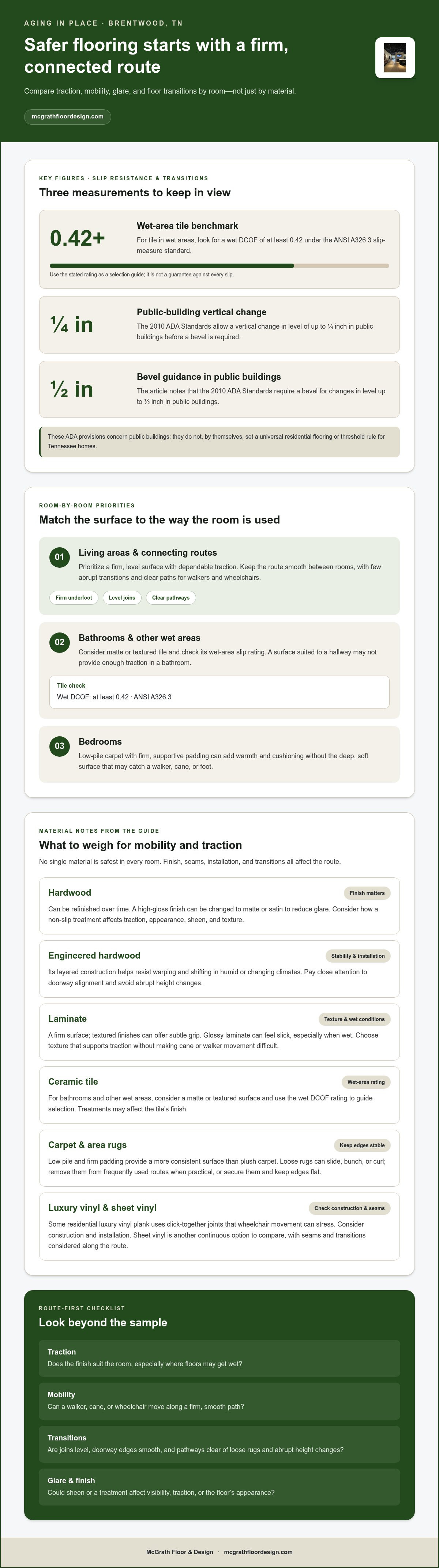
Bathroom flooring needs dependable traction under damp conditions. Choose matte or textured ceramic tile rather than a glossy finish, which can become slippery when wet. For tile in wet areas, look for a wet DCOF of at least 0.42, using the ANSI A326.3 slip-measure standard. This gives you a concrete rating to compare across tile styles, instead of relying only on appearance or touch.
Consider the tile’s layout as well as its rating. A textured surface can support grip, but wide grout joints or uneven tile edges may create trip points. Before choosing a style, examine the full surface and consider how grout lines cross the route between the bathroom door, sink, and shower. Keep transitions with neighboring flooring as flush as possible, and wipe up standing water promptly.
Polished tile and stone can be slippery when wet, so avoid glossy finishes in bathrooms and other splash-prone spaces. If you prefer a polished look, choose slip-resistant texturing and a non-glossy finish where possible. Non-slip mats can add grip beside a sink or shower, but place them flat and make sure their edges do not curl. This everyday detail matters as much as the floor material.
Bamboo needs a water-resistance rating, and its finish matters too. Avoid glossy bamboo in areas exposed to moisture, since a wet, reflective surface may be slippery. In a kitchen near a sink, clean spills promptly and follow the floor’s care requirements. Bamboo offers a different look from ceramic, but its water resistance should guide where it is used.
Cork provides traction and a softer, shock-absorbent feel, but it is not waterproof and is not recommended for high-moisture areas. It also needs sealing to resist spills. This makes cork less practical in a bathroom than tile; in a drier room, consider how walkers, wheelchairs, or rolling scooters may wear or damage it. Both moisture exposure and mobility equipment affect durability.
Modern laminate can resist scratches, which may help in busy rooms with pets or frequent movement. However, glossy laminate can be too slick when wet, so choose products specifically tested for slip resistance. Compare the surface and finish in the room where it will be used, such as a hallway or kitchen. A scratch-resistant finish is not automatically slip-resistant.
To reduce trip risks, inspect the whole route, not just the central floor area. Look for loose tiles, uneven edges, abrupt transitions, and changes in floor height between rooms. A flat, securely positioned entry mat can catch moisture without becoming a raised obstacle. These checks help balance traction, durability, and accessibility in daily life.
5. Flooring choices for aging in place
Hardwood, luxury vinyl, tile, and carpet suit different needs. Hardwood and luxury vinyl provide firm surfaces, while carpet adds cushioning but can impede wheelchair movement. Textured, matte tile can offer traction in wet rooms, though polished finishes may become slippery. When comparing Brentwood TN flooring for aging in place, match each option to the room’s function and how its occupants move through it.
Start with the route used most: entry, hallway, living room, bedroom, and bathroom. Check for loose boards, cracked tiles, bumps, soft spots, and abrupt transitions. These can catch a toe, cane, walker, or wheelchair caster. A continuous, smooth route with minimal seams makes everyday movement easier than choosing one material based only on appearance.
Hardwood offers a firm walking surface and can be sanded and refinished multiple times over its life. A matte or satin finish can reduce glare compared with a high-gloss surface. Wider planks can also make the floor appear less visually busy. Consider hardwood in living areas where a stable surface matters, and plan transitions carefully where it meets another material.
Luxury vinyl is resilient, with a firm surface and some give underfoot. Waterproof options can suit areas where spills occur, but residential click-together planks may not work well for wheelchair use. Product construction matters. Consider how the installed surface, seams, and transitions will handle rolling wheels along the route between a bedroom and bathroom.
Ceramic tile is easy to maintain and can work well in bathrooms when its surface is matte or textured. Glossy tile may become slippery when wet, while uneven pieces or wide grout joints can create trip hazards. Choose tile for the room’s moisture exposure and daily use, then examine how its texture feels underfoot. A flat, even installation matters as much as style.
Low-pile carpet can bring warmth and cushioning to a bedroom, but thick, plush carpet may make it harder to move walkers, canes, and wheelchairs. It can also trap dust and debris. If carpet suits the room’s comfort needs, choose a low profile and firm padding. Keep edges secure and avoid loose rugs along the main path.
Color and light affect how clearly people see the floor. Consistent floor color and minimal glare can help people with reduced vision distinguish spaces. Keep walkways clear of cords, small furniture, and unnecessary rugs. Bright lighting in hallways, stairwells, and entry points can make changes in floor surface easier to notice during daily movement.
For a practical decision, rank each room by moisture, mobility needs, comfort, and cleaning demands. A bathroom calls for traction when damp; a bedroom may benefit from low-pile carpet; a wheelchair route favors firm, smooth flooring with few transitions. A thoughtful plan for Brentwood TN flooring for aging in place weighs those room-by-room needs together. Explore hardwood and laminate flooring options as you compare materials for your home’s function.
McGrath Floor & Design: Hardwood Flooring
McGrath Floor & Design helps homeowners compare hardwood flooring, laminate floors, and ceramic for their rooms and everyday needs. If you’re weighing a firm surface for a main walkway against a different finish for a bathroom, the team can guide you through material selection and installation considerations. Share how you use each space, including whether walkers or wheelchairs need a clear route, and discuss how flooring choices can work with your home’s design. A thoughtful comparison can bring practical needs and a cohesive look together. To discuss flooring options for your home, contact McGrath Floor & Design.
Plan a Floor That Fits the Years Ahead
Think of flooring as part of how your home can support everyday routines over time. Before choosing a material, note where you pause, turn, carry items, or move between rooms. These details help clarify which areas need extra attention and where a consistent look or surface may make the home easier to use.
For aging in place in Brentwood, TN, start with a practical conversation about your priorities. Bring a simple room-by-room list, including the spaces you use most and any mobility changes you’re planning for. This helps you weigh appearance and function together instead of treating every room as a separate design decision.
A considered flooring plan can help your home feel welcoming now while supporting future needs. Contact McGrath Floor & Design to discuss your flooring plans and explore an approach that suits your home. Take the next step at your own pace, with a clearer vision for the spaces you live in every day.
Frequently Asked Questions
What is the best flooring for seniors?
Firm, level flooring with steady traction is a strong starting point, but the best material depends on the room and the person’s routine. Someone who uses a cane, for example, may prioritize a stable path from the bedroom to the kitchen, while another homeowner may value softer bedroom flooring. Consider how the person walks, turns, and enters each room before choosing a surface.
Is carpet bad for seniors who use a walker?
Carpet isn’t automatically unsuitable, but thick or plush carpet can make a walker harder to push and may catch its feet. If you keep carpet in a bedroom, choose a low profile and firm padding, then test how the walker moves across it. Secure carpet edges and remove nearby loose rugs. Replace worn, rippled, or bunched sections that could interrupt the walker’s path.
How high a threshold can a walker go over?
A low, beveled transition is easier to cross than a sharp raised edge, but a walker’s wheels and the user’s balance affect what feels manageable. The 2010 ADA Standards allow a vertical change in level of up to 1/4 inch in public buildings before a bevel is required, according to the U.S. Department of Justice. They require a bevel for changes in level up to 1/2 inch in public buildings.
Is luxury vinyl plank good for wheelchairs?
Some luxury vinyl plank installations can work for wheelchair routes, but residential click-together products may be a poor fit because wheelchair movement stresses their joints. Consider the product construction, floor base, and transition details together. Wheelchair users should also consider turns near a bed or doorway, where wheels pivot. A smooth, stable route with minimal seams matters more than choosing planks by appearance alone.
What About Flooring for Wheelchair Users?
Wheelchair-friendly flooring lets wheels roll without catching at seams, edges, or changes between rooms. Hardwood, laminate, and other firm surfaces can be easier to cross than thick carpet. For a practical check, trace a route from the home’s entrance to the rooms used most, including doorways and turning areas. Look for surface irregularities that could interrupt movement or make steering harder.
What is the best type of flooring for aging adults?
There isn’t one best material for every aging adult or room. Someone who values warmth may prefer low-pile carpet in a bedroom, while a frequent walker or wheelchair user may prioritize firm flooring along the main route. In an active kitchen, consider how spills and cleaning affect the floor. Choose according to daily tasks, mobility needs, comfort, and the surface’s performance in that room.
What is the safest flooring for aging in place?
The safest choice combines a stable walking surface, useful traction, and clear transitions across the areas used every day. Look beyond the material: lighting, loose objects, and floor condition also affect how easily someone can navigate a room. A useful first step is to inspect the home’s main route in daylight, then note loose boards, uneven edges, or places where the flooring changes.
What flooring is safest for aging in place in Brentwood, TN?
For Brentwood, TN, flooring for aging in place should suit each room’s use and the resident’s mobility. Consider hardwood or laminate for firm routes, and ceramic tile where a textured, matte surface suits the room. Compare samples in the home’s lighting, since glare and color contrast can affect how clearly floor boundaries appear. Prioritize a consistent route between frequently used spaces, then tailor room choices to comfort and moisture.


