
When comparing Brentwood TN basement flooring options, start with the room’s moisture conditions and existing floor, then consider how you plan to use the space. A family room, guest room, and home office can each call for different priorities. The same approach helps homeowners in nearby Franklin narrow their choices, too.
It’s easy to focus first on the look of hardwood, laminate, or ceramic. But basement flooring also needs to suit the room’s conditions and everyday demands. Compare product guidance and installation requirements before settling on a style.
This guide compares hardwood, laminate, and ceramic for a Brentwood basement, including how intended use and subfloor conditions shape the decision. At McGrath Floor & Design, our team brings more than 50 years of combined industry experience to flooring selection and professional installation. Seeing finishes in person can help you compare color and texture with the practical needs of your home.
Key Takeaways
- Compare Brentwood TN basement flooring options by considering observed room conditions and intended use, not just the fact that the room is below grade.
- Weigh hardwood, laminate, and ceramic against your design preferences, care expectations, and the basement’s practical demands.
- Review product specifications and installation requirements alongside the existing floor and subfloor before choosing a material.
- Prepare for flooring discussions with room measurements, photos, and notes about conditions you’ve observed.
- Explore flooring samples in person and get guidance on selecting and professionally installing an option for your Brentwood home.
How Brentwood Basement Conditions Shape Your Flooring Choice
Planning a basement floor can feel less straightforward than choosing flooring for an upstairs room. One basement may be a quiet office with a stable, finished floor; another may have visible staining, a persistent odor, or areas that feel damp. How you plan to use the room matters, too. A family space used every day has different comfort and cleanup priorities than a room opened only for guests.
For Brentwood TN basement flooring options, don’t treat “below grade” as a verdict on hardwood, laminate, or ceramic. The room’s observed conditions, existing floor and subfloor, product specifications, and installation requirements all inform the decision. A general overview of basement construction and moisture considerations can provide context, but it can’t establish what’s happening in your particular room.
Look for clues and record them rather than diagnosing the cause by appearance alone. Note dampness, musty or unusual odors, staining, peeling or lifted flooring, and other damage. These observations help describe the room, but a stain or smell by itself doesn’t establish the source or extent of a moisture issue. Assessing the room and subfloor before selecting a finish gives you a more useful basis for comparing materials.
What to assess before choosing basement flooring
Build a simple record before looking at finishes. Photograph areas of concern and note where moisture or staining appears, including whether you observe changes over time. Record the current floor and, if known, the subfloor material. Mark uneven, cracked, loose, or damaged areas and note where they occur. This information keeps the flooring discussion grounded in your basement’s actual condition, not assumptions.
Describe how you expect to use the room, too. A family room, home office, and exercise space each bring different priorities. Room measurements, photos, and written observations help connect your plans with appropriate product and installation requirements.
How intended use changes the flooring brief
Start with everyday experience, not color. Consider how comfortable the floor should feel, the appearance you want, how you need to clean it, and how much foot traffic the room will see. A daily-use family room may call for different care and comfort considerations than an occasional guest room. An office may put more emphasis on the look and feel beneath a desk and chair.
Use these priorities to narrow the material choices before comparing colors or patterns. Hardwood, laminate, and ceramic each bring a different visual character, and their suitability depends on the specific product, room conditions, and installation requirements. Keep your observations and intended use together as you compare options. That way, the finish supports the room’s practical needs as well as the atmosphere you want to create.
Compare Hardwood, Laminate, and Ceramic for a Brentwood Basement
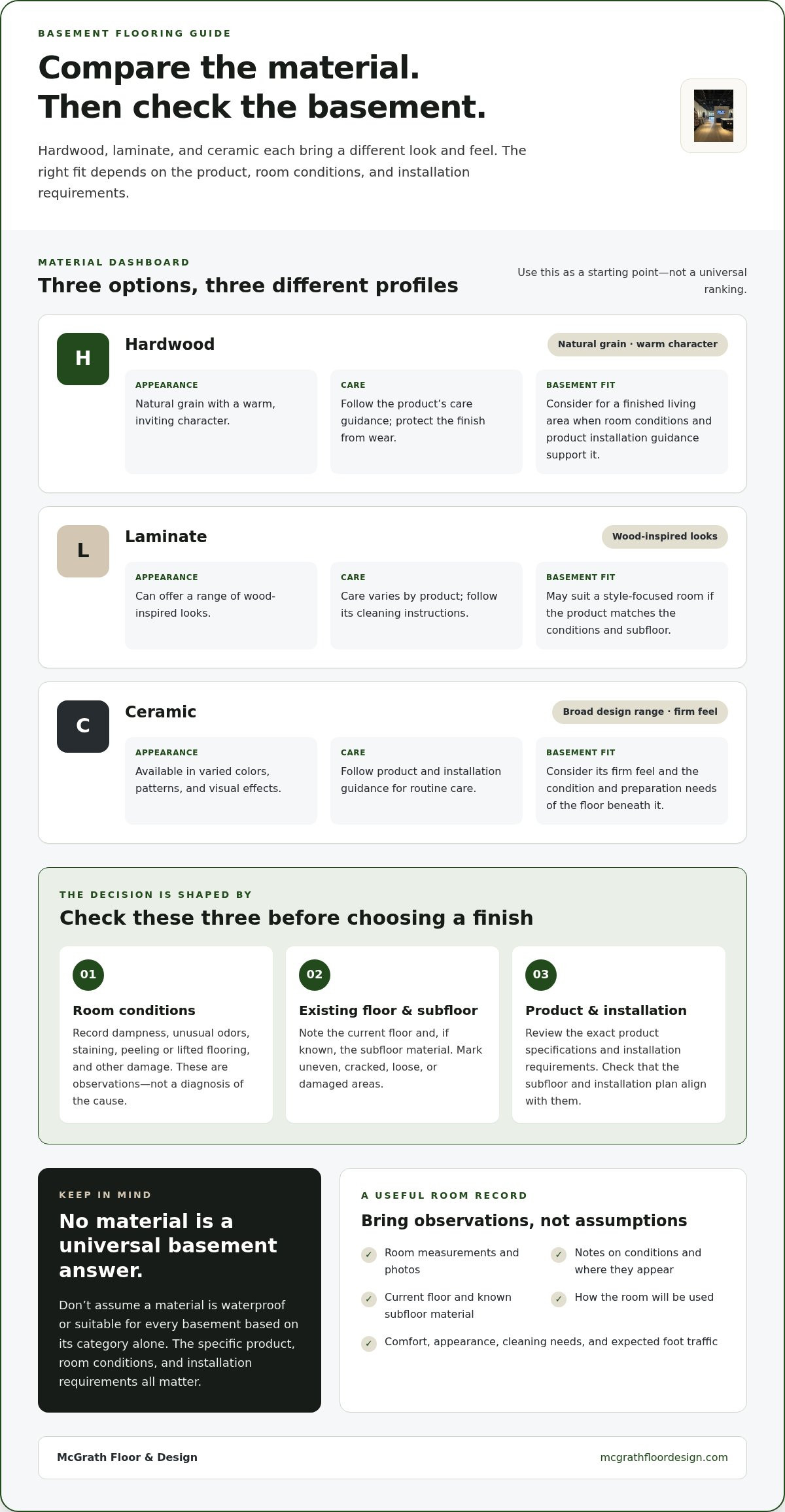
Each material brings a different look and feel, but basement suitability depends on more than the surface you see. Use this comparison to frame the decision, then match the product specifications and installation requirements to the room and subfloor.
| Material | Appearance | Care | Basement considerations |
|---|---|---|---|
| Hardwood | Natural grain and a warm, inviting character | Follow the product’s care guidance; protect the finish from wear | Consider for a finished living area when room conditions and installation guidance support the specific product |
| Laminate | Can offer a range of wood-inspired looks | Care varies by product; follow its cleaning instructions | May suit a style-focused room if the product is appropriate for the conditions and subfloor |
| Ceramic | Available in varied colors, patterns, and visual effects | Follow product and installation guidance for routine care | Consider its firm feel and the condition and preparation needs of the floor beneath it |
This is a starting point, not a universal ranking. A product’s construction and specifications, the room’s conditions, and installation requirements all affect how a floor performs. Don’t assume a material is waterproof or suitable for every basement based on its category alone. Review the guidance for the exact product and make sure the subfloor and installation plan align with it.
When hardwood may fit the basement design
Hardwood can bring natural grain and warmth to a finished living area, especially if you want visual continuity with wood floors elsewhere in the home. The basement’s moisture conditions and the selected product’s installation guidance still matter. Explore hardwood flooring considerations and engineered hardwood installation in Brentwood for related product detail.
How laminate and ceramic differ below grade
Laminate can create a coordinated, wood-inspired look, but its suitability depends on product specifications and room conditions. Learn more about laminate flooring features as you compare options. Ceramic offers a hard surface and broad design range, though the subfloor still needs to meet installation requirements. Both may look distinct from adjoining rooms, so consider transitions and overall flow as well as cleaning needs and underfoot feel.
To compare color and finish, look at samples in person. McGrath Floor & Design helps Brentwood and Franklin homeowners connect product selection with professional installation. Visit the McGrath Floor & Design showroom to explore flooring for your project.
Which Basement Flooring Option Fits Your Priorities Best?
The right choice depends on how the room needs to work, not on a single “best” material. Start by weighing comfort, appearance, care, and the basement’s assessed conditions. Then compare those priorities with the product specifications and installation requirements for hardwood, laminate, and ceramic. A finish that suits a low-traffic guest area may not be the first choice for a busy family room.
Basement flooring selection starts with the room’s conditions and daily use, not the color of the sample. Keep design preferences in the conversation, but treat technical suitability as a separate decision. A color or pattern you love can help narrow suitable products; it can’t establish whether the product and installation are appropriate for the room.
Match flooring to the way you use the room
Picture a typical day in the space. For a family room, consider the look you want, the feel underfoot, and the cleaning routine that fits household activity. In a workspace, think about desk and chair placement, chair movement, and whether you want the floor to connect visually with adjoining rooms. For a utility or laundry area, give room conditions and the product’s instructions priority over appearance alone.
Also distinguish a room used every day from one opened occasionally. Daily use can make comfort and straightforward care more important, while an occasional-use room may put greater emphasis on appearance. These are decision factors, not automatic material rules. Hardwood, laminate, or ceramic could lead the comparison depending on the product, conditions, and installation plan.
Use priorities to narrow the options
Use the table as a planning guide, not a product guarantee. It connects common priorities with questions to weigh before choosing a material. Your room’s conditions and the manufacturer’s guidance still determine which specific products and installation methods are appropriate.
| Room or priority | What to weigh | Materials to compare |
|---|---|---|
| Family room used daily | Comfort, appearance, and the household’s cleaning routine | Compare hardwood, laminate, and ceramic against the room’s conditions |
| Workspace | Furniture and chair movement, plus visual continuity with nearby rooms | Compare hardwood and laminate for a coordinated wood look; consider ceramic if its feel and appearance suit your workspace |
| Utility or laundry area | Observed room conditions and product-specific installation instructions | Consider only products whose specifications and installation requirements suit the assessed space |
| Design-led update | Color, pattern, and how the finish relates to adjoining floors | Compare samples of all three materials after narrowing by suitability |
Address moisture concerns without guesswork
No material choice replaces an assessment of moisture and subfloor conditions. Product suitability and installation methods vary by manufacturer, so follow current guidance for the exact product being considered. If observed conditions are unresolved, assess them before treating a finish choice as final. McGrath Floor & Design helps Brentwood homeowners compare hardwood, laminate, and ceramic in person and connects product selection with professional installation. Visit the McGrath Floor & Design showroom to explore options for your project.
A Brentwood Basement Flooring Checklist Before You Buy
A little preparation can make comparing Brentwood TN basement flooring options more productive. Bring information that connects the room’s actual conditions and planned use with flooring product and installation requirements. Focus on documenting what you know about the existing floor and the space rather than assuming every basement needs the same approach.
Prepare the basement for a useful flooring consultation
Gather measurements, photos, and notes before comparing samples. Together, these details create a practical picture of the space, its finishes, and how you want it to function. Include adjoining rooms and fixed features so the discussion accounts for the whole layout, not just the open floor area.
- Describe the room’s daily use. Note whether you’re planning a family room, office, guest space, or utility area. Include how often household members will use it and what activities the floor needs to accommodate.
- Measure the space and its connections. Record room dimensions, stairs, doorways, adjoining spaces, and fixed features such as built-ins. Photos can help show how the basement connects to the rest of your home.
- Document observed conditions. Photograph dampness, staining, odors, or previous flooring issues, and note where and when you’ve observed them. These clues provide context, but they don’t diagnose the source or extent of a moisture concern.
- Describe the existing floor. Note the visible surface and any known subfloor material. Mark uneven or damaged areas and include close-up photos so they’re easy to discuss.
- Bring design references. Save inspiration images and note colors or finishes you like. Include nearby flooring, wall colors, and other finishes you want the new floor to complement.
Review product and installation details together
As you compare hardwood, laminate, and ceramic, look at appearance alongside the requirements for each specific product. Samples viewed in the basement’s lighting and beside existing finishes can make differences in color and texture easier to judge. Keep practical details in view, too.
- Review product guidance. Read the manufacturer’s instructions for the selected product, including guidance relevant to the room conditions and intended use.
- Discuss installation requirements. Consider how the existing floor and subfloor affect preparation for the material. Preparation needs vary, so don’t assume the same method applies to every product or basement.
- Record care and room considerations. Write down the product’s care guidance and installation details relevant to your space. This gives you a clear reference as you compare options and plan the project.
Bring your measurements, photos, and notes to McGrath Floor & Design to explore hardwood, laminate, and ceramic with personalized guidance for your Brentwood home. Explore flooring options with McGrath Floor & Design and connect your material choice with professional installation.
Choose and Install Basement Flooring with McGrath Floor & Design
A basement flooring project brings design choices and practical planning together. McGrath Floor & Design helps Brentwood homeowners compare hardwood, laminate, and ceramic, then provides professional installation. The goal is to make a considered choice based on how you want to use the room, the look you prefer, and the conditions and installation requirements of your home.
From material selection to a finished basement
Start with your plans for the room. A family space, office, or guest area may call for different priorities around appearance, comfort, and care. Sharing those preferences gives the team a useful starting point for discussing materials. At the showroom, compare flooring appearance and finish in person, then consider how each option relates to the rest of your home.
Selection and installation planning go hand in hand. The existing floor, subfloor, and room conditions are relevant to the installation approach, and product requirements differ. McGrath’s team guides you through product details and installation considerations for your project, keeping the discussion specific to your home rather than relying on a one-size-fits-all recommendation.
Bring your measurements, photos, and notes about observed conditions to make the discussion concrete. If you’ve narrowed your choices, share what appeals to you and what you’re still weighing. You don’t need to have every detail decided before exploring options. A clear picture of the room and its intended use helps turn initial ideas into a practical plan.
Why work with a local flooring team
McGrath Floor & Design serves Brentwood, Franklin, and the Greater Nashville area with flooring selection and professional installation. The owners and partners bring more than 50 years of combined industry experience to guiding homeowners through material choices. Local guidance keeps plans grounded in the specific room you’re updating, while in-person samples make it easier to compare finishes and visual details.
Choosing flooring is only one part of the project. Connecting product selection with installation planning helps you consider how the material, existing floor, and manufacturer’s requirements fit together. McGrath works with you through those decisions, tailoring the discussion to your basement and design preferences instead of assuming every home needs the same solution.
If you’re ready to explore Brentwood TN basement flooring options, bring your room details and questions to McGrath Floor & Design. Discuss your basement flooring project and take the next step toward selecting hardwood, laminate, or ceramic for your home.
Take the Next Step Toward a More Welcoming Basement
A basement renovation is an opportunity to make an underused area feel like a natural extension of your home. Picture how you want the room to welcome you: a place to unwind, focus, or spend time together. With that vision in mind, Brentwood TN basement flooring options become easier to evaluate because you can consider each choice in relation to the atmosphere and everyday experience you want to create.
Give yourself room to compare. Notice how different finishes look alongside existing materials, and keep the room’s conditions and installation requirements in the conversation as your plans take shape. A thoughtful selection can bring design ideas and practical needs into alignment.
McGrath Floor & Design can help you explore hardwood, laminate, and ceramic flooring for your project and plan professional installation. Explore basement flooring options with McGrath Floor & Design and take a confident next step toward making your basement feel more like home.
Frequently Asked Questions
Can flooring be installed directly over a concrete basement slab?
Sometimes, but the slab’s condition and the flooring product’s installation instructions determine whether direct installation is appropriate. Look for uneven areas, visible damage, and signs of moisture, and assess the surface before choosing an installation system. A slab that looks dry may still have moisture concerns that aren’t visible. For Brentwood TN basement flooring options, base the plan on the specific product and slab rather than assuming one method suits every basement.
Does a basement need a moisture barrier under new flooring?
Not every basement flooring project calls for the same moisture-control layer. Whether one is needed, and which type is appropriate, depends on the slab, selected flooring, and manufacturer’s installation instructions. A barrier isn’t a universal fix for active moisture. If you’ve identified a moisture issue, address it as part of project planning, then choose an assembly designed for that basement and flooring product.
Can basement flooring be installed over radiant heat?
Possibly, but compatibility varies by material and product. Before installation, compare the flooring manufacturer’s requirements with details for the heating system, including any temperature limits and approved installation method. Hardwood, laminate, and ceramic shouldn’t be assumed to respond identically. Gather the system information and review it alongside the flooring specifications so the material and installation plan are coordinated.
How should flooring transition from a basement to the stairs?
Plan the stair connection as part of the flooring layout, not as a finishing detail to decide at the end. Stair edges, changes in floor height, and the material upstairs all affect the transition. The selected flooring and installation system guide which trim and finish details are appropriate. Comparing these details early helps create an intentional visual connection and avoids an awkward change in level.
How do you maintain ceramic flooring in a basement?
Follow the care directions for both the ceramic flooring and its grout. For routine cleaning, sweep or vacuum loose debris, then use a cleaner suitable for the specific materials rather than assuming every household product is appropriate. Wipe spills and keep an eye on grout, particularly in utility areas where liquids may be present. The product and grout instructions should guide any additional cleaning or care steps.
Can laminate flooring work in a basement laundry room?
It depends on the exact laminate product, its approved uses, the room conditions, and its installation requirements. A laundry area can involve spills or moisture around appliances, so don’t assume every laminate floor is suited to that setting. Review the manufacturer’s specifications and consider how the room is actually used, including where spills may occur, before selecting flooring and planning installation.


